When planning your next build — whether it’s your dream home, a commercial site, or a public works contract — one of the first questions you’ll face is deceptively simple: Which cement grade should I choose?
It sounds technical. But in practice, it’s a commercial decision. The grade you choose affects not just strength, but cost per square foot, speed of construction, long-term durability, and maintenance spend over decades.
And here’s the truth: if you’re buying based on price per bag alone, you could be spending more overall.
Let’s break it down.
What Cement Grades Actually Mean for Your Budget
In India, the most common cement grades in the market are 43 grade (OPC), 53 grade (OPC) and PPC (Portland Pozzolana Cement). Each has a different compressive strength — but more importantly, each behaves differently during and after construction.
43 grade cement gains strength gradually. It’s reliable and cost-effective for residential slabs, columns, and basic structures. But it sets slower, which may extend your labour or formwork rental costs.
53 grade cement, on the other hand, gains strength quickly. Ideal for high-stress load-bearing components and fast-paced projects. Yes, the cost per bag is higher — but if it lets you pour, set, and move to the next stage faster, that’s labour saved.
PPC, though ungraded numerically, is blended for higher durability, reduced cracks, and environmental benefits. It’s not about speed; it’s about long-term resilience — especially in regions like the Northeast where humidity and rainfall can degrade lower-quality cement over time.
Cement Is Not a Commodity. It’s a Contract with Time, Weather, and Money.
Imagine this: Two contractors bid on a school project. One opts for PPC, the other for OPC 43.
On paper, the second bid is cheaper by ₹8 per bag.
But six months after completion, surface cracks appear, requiring patch-ups. By the first monsoon, there’s visible wear.
Meanwhile, the PPC structure holds up with zero callbacks.
The difference? Cement grade isn’t just a technical choice — it’s a decision about how much future cost you’re willing to absorb today.
Decision Matrix for Buyers in Assam & Northeast India
To help you evaluate smartly, use this matrix — not all cost decisions are the same:
| Criteria | Go with OPC 43 | Go with OPC 53 | Go with PPC |
| Budget-Limited Project | Most cost-effective | Not ideal | Viable if timeline is flexible |
| Fast Completion Required | Slower set | Ideal for quick set and early strength | Not suitable |
| High Rainfall/Water Exposure | Risk of degradation | Better than 43 but still OPC | Best option for long-term durability |
| Mass Concreting or Foundations | Limited performance | Suitable | Best for thermal resistance |
| Long-Term Maintenance Concerns | Higher risk of cracks | Moderate | Low maintenance lifespan |
AmritCem offers all three grades, but always recommends site-specific selection. A hillside home in Mizoram faces different conditions than a township road in Tripura.
Regional Buying Tip
In states like Assam, where cement must often travel long distances, freight becomes a hidden cost. Choose a brand like AmritCem with local distribution centers or depots. You’ll save on transport, reduce delay risks, and often get fresher cement (important for grade performance).
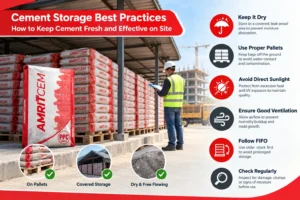
Also consider seasonality: avoid buying in bulk during peak monsoon unless storage is airtight. Even a few weeks of moisture exposure can reduce active grade strength.
Choose Based on Cost per Cubic Metre, Not Bag Price
A common mistake: comparing prices at a per-bag level without understanding the final cement-to-concrete yield.
Example: OPC 53 might cost ₹15 more per bag than OPC 43. But if it gives you a higher yield due to better mix performance or reduces labour/curing time, the per-square-foot cost may end up lower.
Your smart choice lies in the total cost-to-performance ratio, not just the sticker price.
Why AmritCem Fits Commercial Buyers in the Northeast
We’re not here to tell you which grade to buy. We’re here to make sure you don’t buy wrong.
AmritCem works closely with on-ground engineers and petty contractors across Assam, Meghalaya, and Tripura. We’ve seen 43 grade cement crumble under extreme monsoon loads — and we’ve seen PPC reduce maintenance calls for over 10 years.
So our advice is simple: decide based on what your site, structure, and schedule demand — not just bag rate.
When in doubt, speak to our site support team. We’ll help you match grade with actual performance needs — before the purchase, not after the cost.
Ready to choose the right cement grade for your next project?
Get a locally available, BIS-certified AmritCem recommendation now.
Your structure — and your budget — will thank you later.
FAQs
1. Which cement grade is best for house construction?
For most residential projects, OPC 43 grade cement is a cost-effective choice that provides adequate strength for slabs, beams, columns, and general construction. PPC cement is also preferred when long-term durability is a priority.
2. What is the difference between OPC 43, OPC 53, and PPC cement?
OPC 43 offers gradual strength gain and affordability, OPC 53 provides higher early strength for faster construction, while PPC delivers better durability, crack resistance, and performance in humid or high-rainfall conditions.
3. Is OPC 53 cement stronger than OPC 43 cement?
Yes. OPC 53 develops higher compressive strength at an earlier stage than OPC 43, making it suitable for high-load structures, commercial projects, and fast-track construction schedules.
4. Which cement is best for Assam and Northeast India’s climate?
PPC cement is often recommended for Assam and Northeast India because it offers better resistance to moisture, rainfall, and long-term weather-related deterioration compared to conventional OPC cement.
5. Should I choose cement based on bag price or overall project cost?
You should compare the total cost-to-performance ratio rather than the price per bag. A higher-grade cement may reduce labour costs, curing time, maintenance expenses, and overall construction costs over the life of the structure.