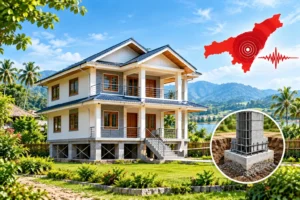

There is something about building a home in Northeast India that people outside the region rarely understand.
The house is not simply built.
It is tested.
Tested by months of rain. Tested by air that rarely feels dry. Tested by moisture that quietly finds its way into walls, foundations and concrete, year after year.
That is why the conversation around cement needs to change. For decades, most homeowners have asked one question.
“Which cement is the strongest?”
It is a fair question.
But perhaps not the most important one.
A better question would be:
Which cement will keep my home stronger after twenty monsoons?
Because strength builds a structure. Durability protects it. And in Northeast India, durability is often the bigger challenge.
A House in Meghalaya Lives a Different Life Than One in Rajasthan
Imagine two identical houses.
Same architect.
Same contractor.
Same concrete mix.
Same steel.
The only difference is where they are built.
One stands in Jaipur.
The other in Shillong.
Ten years later, they may not look the same. Not because one contractor worked harder. Not because one cement was mixed differently. But because the environment kept asking different questions. The house in Rajasthan deals with heat. The house in Meghalaya deals with moisture. Every single day.
That difference changes everything. It changes how concrete behaves. It changes how water moves. It changes how steel survives inside reinforced concrete. It even changes what kind of cement makes the most practical sense.
This is exactly why engineers don’t design concrete based only on strength.
They design it according to exposure conditions, a principle recognised in Indian standards for durable concrete construction.
Rain Is Only Half the Story
When people think about Northeast India, they immediately think about rainfall.
That is true.
But rainfall is not the real challenge.
Moisture is.
Rain falls for a few hours. Humidity stays for months. Concrete doesn’t deteriorate because rain touched it once. It deteriorates when moisture keeps entering it over years.
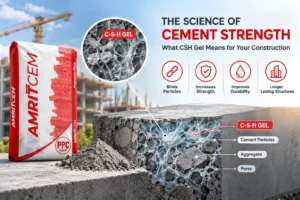
Think of concrete like a sponge. A very hard sponge. It looks solid. But under a microscope, it contains millions of tiny pores. If those pores remain open, water slowly travels inside. Along with that water come oxygen, carbon dioxide and dissolved salts naturally present in the environment.
None of them damage concrete overnight.
They work quietly.
Patiently.
Year after year.
This is how damp walls begin.
This is how reinforcing steel starts corroding.
This is how tiny cracks slowly become expensive repairs.
Most homeowners never notice the beginning.
They only notice the bill.
The Strongest Concrete Is Not Always the Most Durable Concrete
This surprises many people.
High strength and long life are related. But they are not identical. A concrete cube tested in a laboratory may achieve excellent compressive strength. That doesn’t automatically mean it will resist decades of moisture.
Engineers ask another question.
How easily can water enter the concrete?
Because once water begins travelling through concrete, durability slowly starts becoming a concern.
That is why modern concrete design focuses on reducing permeability.
It sounds technical.
It is actually simple.
Lower permeability means fewer pathways for water.
Fewer pathways mean less moisture movement.
Less moisture movement means better protection for concrete and the steel hidden inside it.
That is one of the biggest reasons Portland Pozzolana Cement has become such a preferred choice for residential construction in humid regions.
Not because it is louder.
Because it is denser.
Cement Doesn’t Stop Working After Seven Days
Most people believe cement finishes its job once the concrete hardens.
It doesn’t.
Cement continues reacting with water long after construction.
This process is called hydration.
You don’t need to remember the word.
You only need to remember what it does.
It slowly fills microscopic spaces inside concrete.
Some cements complete most of their work early.
Portland Pozzolana Cement continues improving the concrete structure over a longer period.
That gradual development creates a denser internal matrix.
And a denser concrete naturally makes it harder for moisture to travel through it.
For a region where moisture is the biggest enemy, that is a meaningful advantage.
Not during construction.
For decades afterwards.
Why Portland Pozzolana Cement Was Created in the First Place
Many homeowners think PPC is simply another cement grade.
It isn’t.
It was developed to solve a problem.
Ordinary Portland Cement develops strength quickly.
That makes it excellent for many structural applications.
But engineers also wanted concrete that could become denser with time.
Concrete that offered better long-term durability.
Concrete that resisted water movement more effectively.
That is where Portland Pozzolana Cement came in.
By combining Portland cement clinker with carefully selected pozzolanic materials, PPC continues developing beneficial reactions long after the initial setting period.
Those additional reactions help reduce pore connectivity inside hardened concrete.
You don’t see that happening.
You don’t hear it.
But your house benefits from it every monsoon.
Why So Many Contractors Prefer PPC for Homes
Visit enough construction sites in Meghalaya or Assam and you will notice something interesting.
Many experienced contractors recommend PPC for residential homes.
Not because it is fashionable.
Because they have watched houses age.
They know what repeated dampness does.
They know which walls remain healthier after years.
They know which plaster develops fewer shrinkage cracks.
Experience teaches lessons that brochures never can.
That is why PPC is commonly preferred for:
- Foundations
- Masonry work
- Residential slabs
- Plastering
- General home construction
Not because other cements are inferior.
Because these applications benefit from long-term durability, lower permeability and improved moisture resistance.
Those qualities become especially valuable in Northeast India’s climate.
Climate Doesn’t Read Brand Names
This is perhaps the simplest way to understand cement selection.
Rain does not care whether the bag carries a famous logo.
Humidity does not recognise advertisements.
Moisture doesn’t stop because the cement was expensive.
Nature tests only one thing.
How well was the concrete built to resist it?
That depends on several factors.
- Good cement.
- Correct water-cement ratio.
- Proper compaction.
- Adequate curing.
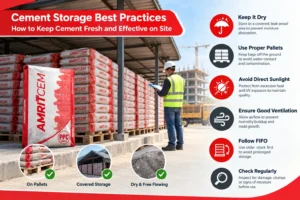
- Fresh material.
- And choosing the right cement for the environment instead of simply choosing the most popular brand.
That distinction is easy to overlook.
Until the house has lived through ten or fifteen rainy seasons.
The Difference Becomes Clear Years Later
The biggest advantage of a durable cement is that it rarely announces itself during construction.
It reveals itself much later.
When neighbouring walls begin showing damp patches.
When paint starts peeling.
When tiny cracks begin widening.
When repairs become part of annual maintenance.
That is when homeowners realise they were never buying cement for Day One.
They were buying it for Year Twenty.
And that changes the conversation completely.
Why Amrit Cement PPC Fits the Northeast Better
Some products are designed for a market.
Others grow with it.
Amrit Cement belongs to the second category.
Its manufacturing presence in Meghalaya means the company understands the construction realities of Northeast India firsthand.
The climate.
The terrain.
The transportation challenges.
The way contractors actually build.
This understanding reflects in its Portland Pozzolana Cement, developed to support long-term durability in conditions where moisture is a constant part of life.
For homeowners, that translates into practical benefits.
- Better resistance to moisture ingress.
- Dense concrete development over time.
- Improved durability for residential construction.
- Consistent quality backed by regional manufacturing.
- Reliable availability across Northeast India.
It is not about promising a perfect house.
No cement can do that.
It is about giving your home a stronger chance against the environment it will face every year.
A Home Doesn’t Remember What You Paid for Cement
It remembers what you built it with.
Years from now, nobody will remember whether one bag cost ₹20 more or less.
But everyone will notice walls that stay healthier.
Concrete that ages gracefully.
Rooms that remain dry.
Repairs that never became necessary.
That is the real return on choosing the right cement.
In Northeast India, construction has never been only about building against gravity.
It is about building against moisture.
Against humidity.
Against years of relentless weather.
That demands more than strength.
It demands durability.
And that is exactly where Portland Pozzolana Cement earns its place.
When developed with regional understanding, manufactured close to the market, and used with proper construction practices, Amrit Cement PPC becomes more than another bag of cement.
It becomes part of a home that is prepared not just for its first monsoon—
but for every monsoon that follows.