
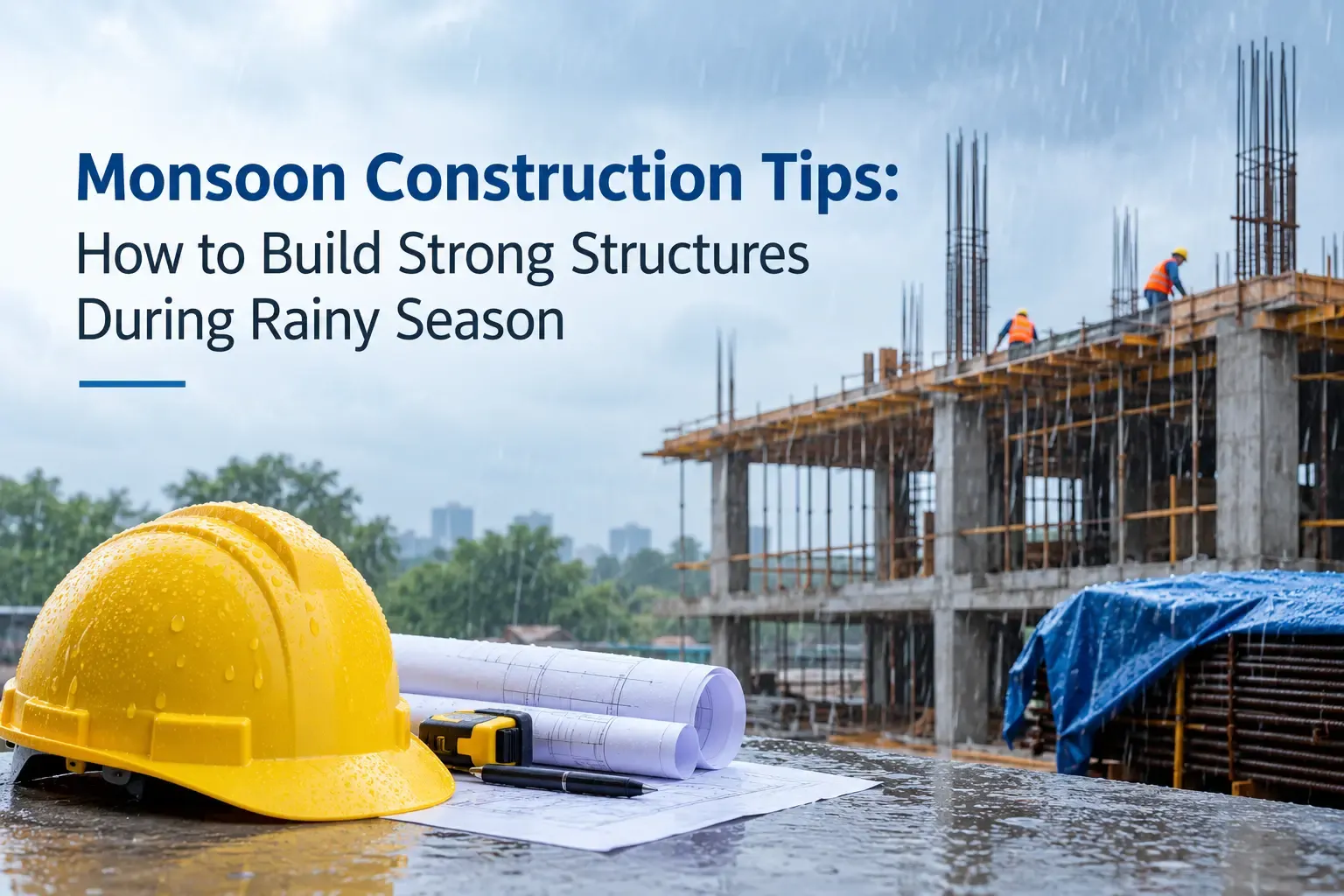
The Monsoon Does Not Mean Construction Has to Stop. It Means Construction Has to Change.
On dry days, the pile of sand can sit in the open, but during the monsoon, the same sand suddenly carries additional moisture. Excavated pits collect water. Cement bags have to fight humidity. Freshly placed concrete may face an unexpected downpour. Access roads become difficult to navigate. And the roof slab you planned to cast tomorrow is now competing with the weather forecast.
This does not automatically make the rainy season a bad time to build.
It makes it an unforgiving time to build carelessly.
A useful monsoon construction guide therefore isn’t about covering the site with plastic and continuing exactly as before.
It is about changing the way the site works.
Before the Rain Comes Down, Make Sure It Has Somewhere to Go
The first monsoon preparation has nothing to do with cement. Start with the site itself.
Look at the site after heavy rain.
- Where will the water collect?
- Where will it leave?
- Can runoff enter foundation trenches?
- Will water accumulate around stored materials?
- Can a sudden downpour flood the working area?
Provide temporary drains, channels or pumping arrangements where necessary before major work begins. Keep excavated soil away from trench edges and prevent runoff from surrounding areas from flowing directly into excavations.
For sloping sites, particularly common across parts of Northeast India, drainage becomes even more important.
Water should be directed. Not discovered.
1. Don’t Pour a Foundation Into a Pond
Excavation during monsoon needs regular inspection.
If a footing pit fills with rainwater, simply pumping the visible water out and immediately concreting may not be enough.
Check whether the soil at the bottom has softened, become disturbed or lost its intended bearing condition.
Loose mud and standing water should not remain beneath foundation concrete.
Where site conditions have changed significantly, the engineer should inspect the excavation before work continues.
The foundation carries your house for decades.
2. Protect Cement Before You Protect Concrete
Cement and unwanted moisture should meet only when you deliberately mix them.
During monsoon, that becomes harder.
Cement is hygroscopic, meaning it can absorb moisture from its surroundings. Poor storage can lead to lump formation and deterioration before the bag ever reaches the mixer.
Store bags:
- Inside a dry, leak-proof shed
- On raised wooden pallets or platforms
- Away from exterior walls
- Away from doors where rain can blow inside
- Under additional waterproof protection when necessary
Use older stock first and inspect every bag before use.
Hard lumps are a warning.
During monsoon construction, storage is not housekeeping.
It is material quality control.
3. Your Sand Is Already Bringing Water to the Mix
This is one of the easiest rainy-season mistakes to miss. A concrete mix may specify a certain quantity of water. But wet sand and aggregates already contain water.
If the batching team adds the normal quantity of mixing water without accounting for aggregate moisture, the actual water-cement ratio can become higher than intended.
And excess water can mean higher porosity, lower strength and reduced durability.
So during wet weather, aggregate moisture should be checked and batch water adjusted accordingly.
Do not judge concrete by saying:
“It looks like it needs a little more water.”
The water you cannot see still counts.
4. Check the Weather Before You Schedule the Pour
This sounds almost too simple to include.
Yet it matters.
Do not begin a large roof slab or critical RCC pour when intense rain is expected and the site cannot adequately protect the fresh concrete.
Light rain after concrete has hardened sufficiently is very different from heavy rainfall striking freshly finished concrete.
Rain can:
- Disturb the fresh surface
- Wash cement paste from exposed concrete
- Introduce uncontrolled water
- Affect finishing
- Cause local surface damage
Keep waterproof covers ready before concreting starts. Not after the first raindrop. And never work through unsafe weather simply to protect a construction schedule.
5. Portland Pozzolana Cement PPC Can Make Sense in a Wet Climate
Rainy-region construction is not only about what happens during the pour.
It is about what the structure will face for years afterwards.
Portland Pozzolana Cement PPC contains pozzolanic material, commonly fly ash, along with Portland cement constituents.
During hydration, the pozzolanic material reacts with calcium hydroxide and contributes additional cementitious compounds such as calcium silicate hydrate.
With proper mix design and curing, this can help refine the pore structure of concrete and support lower permeability and good long-term durability.
PPC also generally develops less heat during hydration than comparable OPC systems.
These characteristics make quality PPC, including Amrit Cement PPC, useful for many durability-focused residential applications in high-rainfall regions, subject to structural specifications.
But there is an important distinction.
PPC can help produce durable concrete.
It does not make poor construction automatically waterproof.
6. Rain Is Not a Substitute for Curing
This is perhaps the biggest misconception about cement curing in rain.
“It has been raining all week. The slab is already being cured.”
Not necessarily.
Curing means maintaining suitable moisture and temperature conditions so cement hydration can continue properly.
Uncontrolled rainfall is not a curing plan.
Heavy rain can damage young concrete before it has hardened sufficiently. Later, a roof may appear wet while sheltered areas, vertical surfaces, slab edges or columns are receiving completely different moisture conditions.
Continue the specified curing method once the concrete is ready for it.
If wet coverings are used, keep them continuously moist.
If ponding is specified for a hardened slab, maintain it properly.
Do not switch curing on and off according to whether it happened to rain that afternoon.
7. Waterproofing Starts Before the Waterproofing Contractor Arrives
A membrane cannot correct every construction mistake beneath it. For a more water-resistant building, start with the structure itself.
- Control the water-cement ratio.
- Compact concrete properly.
- Avoid honeycombing.
- Treat construction joints correctly.
- Provide adequate roof slope.
- Detail pipe penetrations.
- Provide an effective DPC.
- Plan external drainage.
- Then apply the specified waterproofing system correctly.
These are the waterproof construction tips that matter because they remove water pathways rather than simply covering them.
In high-rainfall regions, pay particular attention to roofs, balconies, bathrooms, plinth areas, retaining walls and external wall junctions.
Water needs only one route.
Your job is not to give it one.
8. Don’t Plaster a Wall That Is Too Wet
Monsoon humidity slows drying.
That affects finishing work.
A wall exposed to continuous rain or active seepage should not simply be covered with plaster or paint to keep the schedule moving.
Find the moisture source first.
Likewise, protect newly plastered external walls from heavy direct rainfall during their vulnerable early period.
Before painting, allow substrates to reach the moisture condition required by the coating manufacturer.
Otherwise, moisture trapped behind finishes can later show itself as blistering, peeling or efflorescence.
The monsoon rewards patience.
Finishes applied too early often make you pay for that impatience later.
9. Inspect the Site After Every Serious Downpour
Rain can change a construction site overnight. After heavy rainfall, inspect:
Excavations: Any collapse, erosion or softening?
Formwork: Has anything shifted or filled with water?
Reinforcement: Is it contaminated with mud or debris?
Cement storage: Any leakage or damp bags?
Aggregates: Has moisture content changed significantly?
Fresh concrete: Any erosion or visible surface damage?
Temporary drainage: Is it blocked?
Scaffolding and electrical systems: Are they safe to use?
Do this before restarting work. A monsoon site should not simply resume every morning because workers have arrived. It should resume because conditions are safe and suitable for construction.
What Should You Postpone During Heavy Rain?
Not every activity needs to continue merely because labour is available. Consider postponing exposed work when weather conditions make quality control or worker safety difficult, particularly:
- Critical concrete pours without adequate protection
- External plastering during heavy rain
- Waterproofing on unsuitable wet substrates
- Excavation where collapse or flooding is a concern
- Painting on moisture-loaded surfaces
- Electrical work exposed to water
A construction programme is important.
So is knowing when not to follow it.
Monsoon Construction Is Mostly About Control
You cannot control the rain. But you can control almost everything you do around it.
- Where water drains.
- How cement is stored.
- How wet your aggregates are.
- When concrete is poured.
- How fresh concrete is protected.
- How cement curing in rain is managed.
- Whether waterproofing details are rushed.
- And whether the site is inspected after severe weather.
Using Portland Pozzolana Cement PPC can support long-term durability in suitable applications, particularly when moisture resistance and lower permeability are important.
But cement is only one decision.
Strong monsoon construction comes from hundreds of smaller decisions made before water turns them into problems.
The rain will test the structure eventually. Good construction simply makes sure that test begins on your terms.
Frequently Asked Questions
1. Is Portland Pozzolana Cement PPC suitable for monsoon construction?
Yes. Portland Pozzolana Cement PPC can be suitable for many residential and durability-focused applications during monsoon construction when permitted by the structural design. Its pozzolanic reaction can support lower permeability and long-term durability when concrete is correctly proportioned, compacted and cured.
2. Can concrete be poured while it is raining?
Critical concrete placement should ideally be planned around suitable weather. Light or unexpected rain may be manageable with proper protection, but heavy rain can alter fresh concrete surfaces and introduce uncontrolled water. Follow the site engineer’s instructions.
3. Does rainwater count as concrete curing?
Rain can help keep hardened concrete wet, but it should not replace a planned curing method. Proper curing requires controlled and continuous conditions appropriate to the concrete and construction specification.
4. How should cement be stored during the monsoon?
Keep cement in a dry, leak-proof storage area on raised platforms, away from exterior walls and protected from rain and humidity. Use older stock first and reject bags showing significant moisture damage or hard lumps.
5. Why should water in wet aggregates be considered?
Wet sand and aggregates already contain moisture. If normal mixing water is added without adjustment, the effective water-cement ratio may rise and affect concrete strength and permeability.
6. Does PPC make a building waterproof?
No. PPC can help produce dense, durable and relatively low-permeability concrete, but waterproof construction also requires correct mix design, compaction, curing, drainage, crack control, DPC and suitable waterproofing systems.