A cement bag may look perfectly fine from the outside. But what if it has been stored on a wet floor for weeks? What if the bag is torn? Or what if the cement has started forming hard lumps?
Most homeowners do not think about these things until construction begins.
They usually ask the dealer for a good brand, check the price and place the order.
However, choosing cement requires a little more attention.
Let us explains How to Choose Quality Cement, what to check before buying and how to protect cement after it reaches the site.
1. Start With the Cement Type
The first step is to understand what your construction actually needs.
There is no single cement that is automatically best for every application.
For example, a roof slab, foundation, brick wall and plastered surface have different requirements.
Amrit Cement offers OPC 43, OPC 53 and PPC.
OPC 53 is often considered where higher early-strength characteristics are required. OPC 43 is used for various general construction applications. PPC offers suitable workability and useful long-term durability characteristics when correctly used.
Before buying, ask the contractor or engineer which type is specified.
The best cement for home construction is the one that matches the technical requirements of the project.
A higher grade number alone does not guarantee a stronger house.
2. Check the BIS Certification Mark
One of the most important things to check is whether the cement meets the applicable Indian Standard.
Look for the BIS Standard Mark, commonly called the ISI mark, and the relevant licence and product information.
Different cement types are covered by different standards.
OPC grades fall under IS 269, while fly-ash-based PPC falls under IS 1489 (Part 1).
These standards define requirements related to cement properties and testing.
An authentic certification mark is more useful than relying on a claim printed in large letters on the front of a bag.
Amrit Cement manufactures cement in accordance with applicable BIS specifications and conducts quality checks during production.
3. Read the Information Printed on the Bag
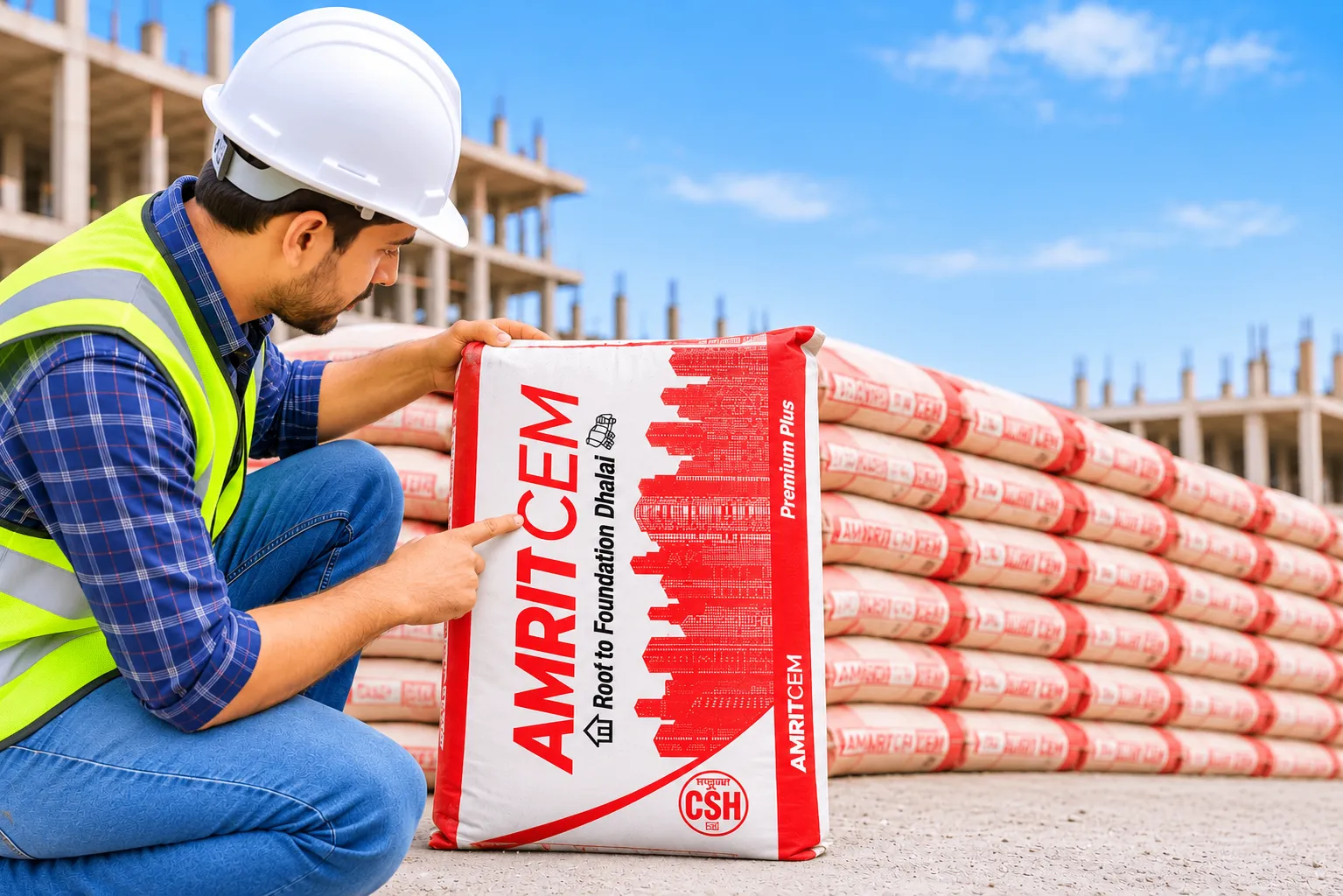
When checking quality cement bags, do not look only at the brand name.
The packaging should provide important product details.
Check the manufacturer, cement type, net quantity, applicable standard, licence details and manufacturing or packing information.
Also check the MRP and any relevant storage instructions.
Manufacturing dates matter because cement can lose its useful properties when exposed to moisture or stored for too long.
For cement that is more than three months old, the applicable requirements call for testing to confirm conformity before use.
This does not mean every older bag is automatically unusable. It means age and storage conditions need proper attention.
A dealer should be able to explain the stock details.
4. Inspect the Physical Condition
The next cement quality check is simple.
Look at the bag.
Is it wet? Is it torn? Are there stains showing moisture exposure?
When a bag is handled, does the cement appear to contain hard lumps?
Hard lumps may indicate that moisture has entered and some cement has already reacted.
Small, soft clumps and hard, solid lumps are not necessarily the same, but damaged or suspicious material should not be used without proper assessment.
Do not accept visibly wet cement bags simply because the dealer offers a discount.
A reduced price cannot compensate for material that may not meet the required quality.
5. Ask How the Cement Has Been Stored
A trusted manufacturer is important.
But storage at the dealership matters too.
Cement should be protected from rain, leaking roofs and damp floors.
Bags should be arranged in a suitable dry storage area, preferably on a raised platform and away from exterior walls.
During the monsoon, this becomes particularly important in Assam, Meghalaya and other high-rainfall areas.
A dealer with a clean, organised storage area is generally preferable to one keeping stock in wet or exposed conditions.
Before placing a large order, it is reasonable to ask how the cement has been stored.
6. Choose a Reliable Dealer
A good cement buying guide should also explain where to purchase cement.
Buy from an authorised, reliable dealer who can provide a proper invoice and product details.
Avoid purchasing bags with unclear branding, damaged markings or doubtful origins.
Check the exact product name before payment.
If the engineer has specified PPC, the delivered bags should be PPC. If OPC 53 has been specified, a dealer should not substitute another product without approval.
At Amrit Cement, customers can use our online Store Locator to identify nearby dealers and enquire about the available product range.
7. Compare Quality Before Price
Price matters when building a house.
But the cheapest bag is not always the best purchase.
A buyer should compare cement type, manufacturer, certification, freshness, storage conditions and delivered cost.
A small saving on the purchase may become irrelevant if the cement is poorly stored or unsuitable for the project.
Also avoid purchasing large quantities simply because a dealer offers a bulk discount.
Cement is better ordered according to the construction schedule when storage space is limited.
8. Protect Cement After Delivery
The quality check does not end at the shop.
Once cement reaches the construction site, store it properly.
Keep bags in a dry room on a raised platform, generally around 150–200 mm above the floor. Maintain separation from damp exterior walls and protect the stack from rainwater.
Use older suitable stock first.
Do not leave cement outside under a loosely placed sheet for several days during heavy rain.
Good storage helps preserve the cement’s condition until workers are ready to use it.
Why Choose Amrit Cement?
At Amrit Cement, we focus on product quality from manufacturing to packaging.
Our manufacturing facility in Meghalaya uses modern quality-control equipment and testing processes to monitor raw materials and finished cement.
We offer OPC 43, OPC 53 and PPC for different construction needs.
Our PPC product is also supplied in specially designed protective packaging intended to reduce moisture exposure during handling and transport.
We still recommend keeping all cement bags in a dry and protected storage area.
Customers can explore our cement products and locate authorised dealers through the official website.
Final Thoughts
Choosing cement is not difficult when you know what to check.
Start with the correct cement type. Look for certification and packaging information. Inspect the bags and ask about storage conditions.
Then buy from a dependable supplier.
These simple steps help homeowners make better decisions before construction starts.
And remember, even high-quality cement needs proper mixing, compaction and curing to deliver the intended results.
FAQs
1. How can I check cement quality before buying?
Check the certification mark, cement type, manufacturer details, packing information and bag condition. Buy from a trusted supplier.
2. Is cement with hard lumps safe to use?
Hard lumps may indicate moisture damage. Such cement should not be used without proper technical assessment or testing.
3. Is OPC 53 always better than OPC 43?
No. The suitable grade depends on the application, approved concrete mix and construction requirements.
4. How old can cement be before it needs testing?
Cement older than three months should be tested for conformity before use, according to the relevant marking and quality requirements.
5. Where can I buy quality Amrit Cement bags?
Customers can use Amrit Cement’s official Store Locator to find suppliers and enquire about the required cement type.