Cement is also considered one of the most extremely necessary construction materials. It is the background of the modern development whether in houses and roads or bridge and big construction projects. Although a large number of the population applies cement on a daily basis in their construction work, very few people know about its production.
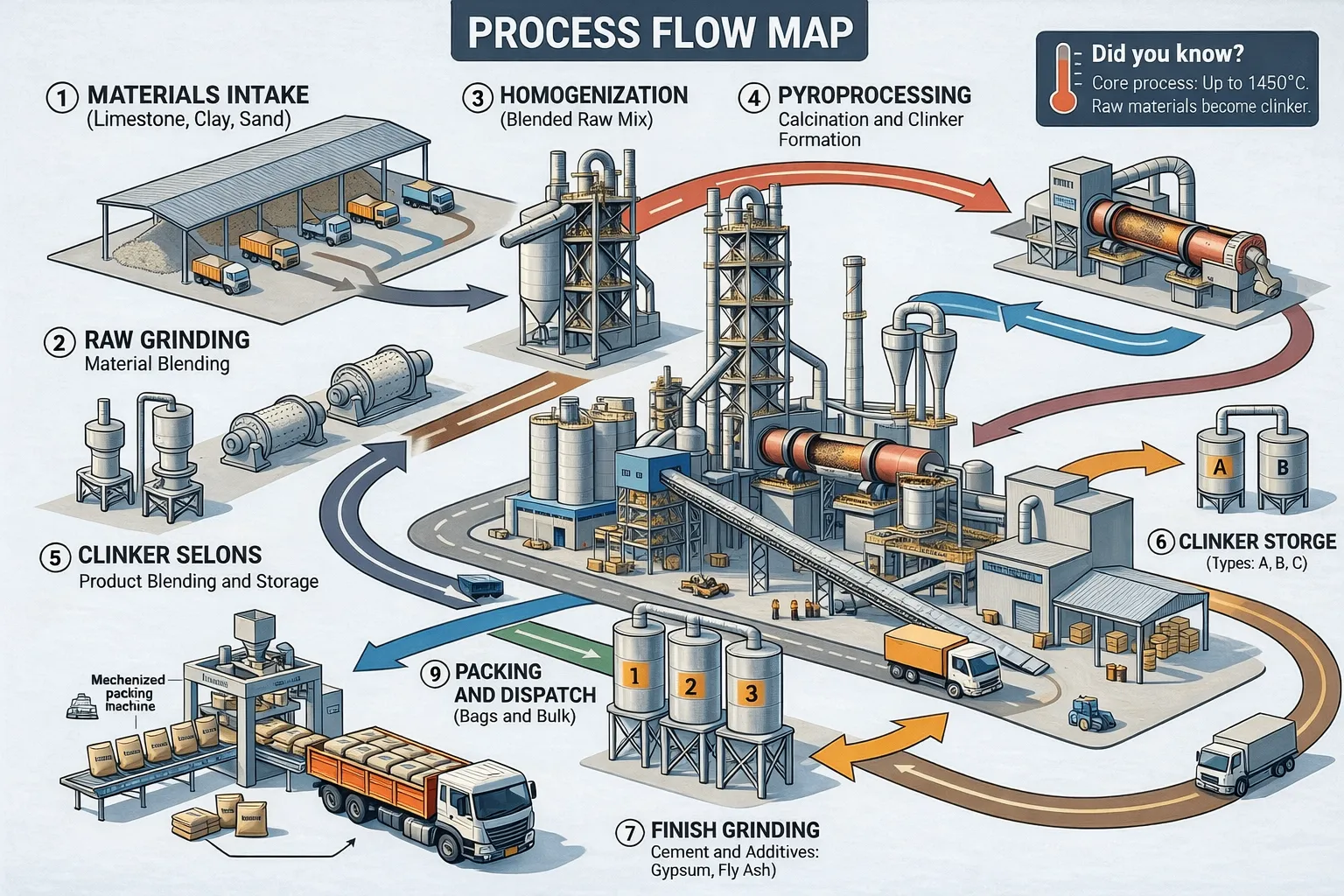
The cement production process involves several carefully controlled stages, starting from mining raw materials to packing the final product. All the steps are aimed at making the cement produced homogenous, dependable and construction worthy.
In this article, we walk through the cement manufacturing process in a simple and practical way so readers can understand how cement moves from natural resources to ready-to-use bags.
1. Raw Material Mining
The cement production process begins with the extraction of natural raw materials from quarries.
Primary Raw Materials
- Limestone (primary material used in cement)
- Clay
- Shale
- Iron ore
- Other minerals
The materials are normally contained in huge deposits that are located underground. The drilling and blasting are some of the ways through which mining crews would crack the layers of rock.
After the loosening of the rocks, the material is collected using heavy equipment tools like:
- Excavators
- Loaders
The materials are then taken to the processing location.
Raw materials are very crucial since this factor directly influences the quality of cement and its power.
2. Crushing the Raw Materials
The big rocks cannot be utilized directly after mining. They must be first cut down into smaller sizes.
In this stage of the cement manufacturing process, the raw materials pass through large crushers.
Purpose of Crushing
- Cut rocks into smaller sizes
- Prepare materials for further processing
- Ensure uniform composition
Crushing makes the materials manageable to the following stages as well as assists in pursuing uniform composition. The correct reduction of the size is significant since non-uniform materials may influence the uniformity of cement and negatively impact the efficiency of the cement production process.
3. Raw Material Blending
After the materials have been crushed, they are then mixed in certain ratios. This step will make the chemical makeup of the mixture balanced.
In the cement production process, even small changes in material composition can affect the quality of the final product.
Materials Balanced During Blending
- Limestone
- Clay
- Silica
- Iron
Manufacturers apply controlled systems to ensure the right combination of materials.
The blended material is normally stored in huge silos, where it is mixed continuously in order to maintain consistency before proceeding to the next process.
4. Raw Grinding
The blended materials then ground into a fine powder called raw meal. Large grinding mills are utilized to grind and crush the blended materials to the desired fineness.
This stage improves chemical reaction efficiency and ensures uniform particle distribution, which directly supports a stable cement production process.
Purpose of Grinding
- Convert materials into fine powder
- Improve chemical reactions in the next stage
- Maintain uniform distribution of materials
Grinding also ensures that the raw materials are evenly spaced. This is significant as homogenous raw meal results in constant and steady cement quality.
5. Preheating the Raw Meal
Before entering the main heating unit, the raw meal passes through a preheating stage.
In this part of the cement production process, the powdered material is exposed to high temperatures using hot gases coming from the kiln.
Functions of Preheating
- Removes moisture
- Initiates mineral transformation
- Prepares the raw meal for chemical reactions
This phase also enhances energy efficiency since the material enters the kiln at a higher temperature.
6. Formation of Clinker in the Kiln
The kiln is the most critical part of the cement manufacturing process.
It is an enormous rotary type furnace where the raw meal is heated to extremely high temperatures.
Temperature Range
1400°C – 1500°C
At this temperature:
- Raw materials chemically react
- Materials fuse together
- This results in the formation of small hard nodules known as clinker
Important Points About Clinker
- It is the intermediate product of cement
- Determines the strength of the final product
The kiln stage requires strict monitoring and temperature control.
7. Clinker Cooling
After leaving the kiln, the clinker is extremely hot.
This step stabilizes the chemical structure and ensures that the cement production process delivers strong and durable cement.
Importance of Cooling
- Preserves chemical properties
- Maintains cement strength
After cooling, the clinker is transported to storage areas before the final grinding stage.
8. Final Grinding
Cement cannot be produced using clinker alone. It must be finely ground together with small amounts of gypsum.
Role of Gypsum
- Regulates the setting time of cement
- Prevents cement from drying too quickly after mixing with water
During this stage of the cement manufacturing process, grinding mills convert clinker and gypsum into the fine powder recognized as cement.
The fineness achieved during this stage significantly influences cement strength and performance.
9. Storage and Quality Checks
The finished cement is stored in large silos before packaging.
These silos help maintain the consistency and quality of the product.
Importance of Quality Control
- Ensures reliability of construction materials
- Maintains product consistency
- Supports construction project safety
Quality control is therefore a key part of the cement production process.
10. Packing and Distribution
The final stage of the cement manufacturing process is packing.
Depending on market demand, cement may be supplied:
- In bags
- In bulk form
Packing Process
- Automatic packing machines fill cement bags
- Controlled weight ensures consistency
- Bags are sealed and prepared for distribution
After packing, cement is distributed through supply channels to:
- Construction sites
- Dealers
- Retailers
From there, it reaches builders, contractors, and homeowners for use in construction work.
Why the Cement Production Process Matters for Buyers
Understanding the whole process helps buyers make informed decisions. A well-controlled cement production process ensures:
- Consistent cement quality
- Better strength and durability
- Reduced chances of defects
- Improved long-term performance
Choosing cement from manufacturers with strong and reliable production standards ensures better construction outcomes.
Final Thoughts
The cement production process is a carefully structured journey that transforms natural raw materials into a reliable construction material.
From mining limestone, to producing clinker, and finally grinding and packing cement, every stage of the cement manufacturing process plays an important role in ensuring quality.
Understanding this process helps users appreciate the amount of effort and technology involved in producing each bag of cement used in construction.
For builders and homeowners, knowledge of cement production also highlights the importance of choosing trusted brands produced under strict manufacturing guidelines, ensuring quality and reliability in construction projects.
FAQs
FAQ 1: Why is the mining stage important in cement production?
The quality of cement begins with the quality of raw materials. Limestone, clay, and other minerals extracted from mines determine the chemical composition of cement. Amrit Cement carefully selects and tests raw materials during mining to maintain the right balance of minerals. This ensures that the cement produced later has consistent strength and durability, which ultimately benefits contractors and home owners relying on dependable construction materials.
FAQ 2: What happens after raw materials are mined for cement?
After mining, raw materials are crushed and blended in precise proportions. The mixture is ground into fine powder and fed into a kiln, where it is heated at very high temperatures to form clinker. Amrit Cement uses advanced manufacturing technology to maintain uniform processing. This stage is crucial because it determines the strength characteristics of the final cement product used in construction.
FAQ 3: How does clinker production affect cement quality?
Clinker is the main component of cement and determines its strength and performance. If clinker quality is inconsistent, cement strength may vary across batches. Amrit Cement produces clinker using controlled kiln operations and advanced monitoring systems. This ensures uniform chemical composition and reliable performance, which is essential for contractors working on large or critical construction projects.
FAQ 4: Why is grinding important in cement manufacturing?
Grinding clinker with gypsum creates the final cement powder. Proper grinding improves fineness and helps control cement setting time. Amrit Cement uses high-efficiency grinding systems to ensure consistent particle size. For contractors, this means smoother mixing, better concrete workability, and dependable structural strength.
FAQ 5: How does packing affect cement quality before reaching the site?
Packing protects cement from moisture and contamination during transport and storage. Amrit Cement uses automated packing systems and strong moisture-resistant bags to maintain freshness and weight accuracy. This ensures dealers receive high-quality cement and contractors get consistent performance at construction sites.