
You painted your walls last year… & they looked brand new the colour was just fabulous, the finish was spotless. But fast forward six months to today & you take a step back to see that the paint is coming off. But it’s not just the paint – there are these nasty yellow-brown stains creeping in near the window frame. And to make matters worse – the wall near the bathroom is now feeling damp to the touch.
You’re not on your own – this type of thing is incredibly common in Indian homes. Damp walls, basically its a plague of Indian homes – that nobody really complains about. According to a survey by the National Building Organisation (NBO) over 60% of residential homes in India show signs of damp within 10 years of construction. In cities that get hammered with rain – like Guwahati, Kolkata & Shillong – the number is even higher.
The real problem though is that most homeowners just treat the symptoms – fix the paint job & ignore the real causes of the damp walls altogether. This post is going to walk you through exactly what’s going on, what it means for your homes structure & most importantly how to get to the bottom of things so its sorted out & stops for good.
Why Damp Walls Occur in Indian Homes
The reasons why your walls are damp all come down to a few key things, including how they were built, where you live, and how well you take care of them. Here are the most common things that cause damp walls to leak:
- When they built your place without a waterproof layer: If your walls never got a decent waterproofing job, moisture will just blow right through.
- Leaky pipes behind your walls: You can have leaky pipes right under your nose – or at least, in your walls – and never even know it.
- Water seeping up from below (groundwater): Moisture from the ground will just keep rising up and up, into your walls, if that’s how your house was built.
- Cracks in the outside of your walls: If the plaster is all cracked and broken, rain is just going to come on in and start causing problems.
- Flat roofs that just can’t keep up: If your roof isn’t sloped properly, water just pools up there and then goes right on into your walls.
- Being in a place that’s just naturally damp : Living in some parts of the country – especially near the coast or in places that get a lot of monsoon rain – is just going to be a bit of a damp adventure, no matter how hard you try to keep things dry.
- Drainage systems that are just not up to snuff: If the drains around your place are clogged up, water is just going to keep on building up and eventually it’s going to make its way into your walls.
Top Reasons for Damp Walls in Indian Homes
1. Poor Building Materials
Number one on the list is the use of cheap materials that compromise the quality of the construction.
Cement grade matters like you wouldn’t believe. So does water to cement ratio, and the quality of the sand being used. And when builders cut costs by skimping on the good stuff, their concrete and plaster end up being completely porous. Porous surfaces let water just waltz right through the wall, courtesy of a process known as moisture ingress.
According to the Bureau of Indian Standards (BIS), they recommend a pretty tight water-cement ratio of 0.45 to 0.55 for standard construction projects. And if you go above that, well, you end up with excess water voids in the concrete. When the water dries, it leaves behind tiny channels for water to sneak in through. Rainwater finds those channels in a flash.
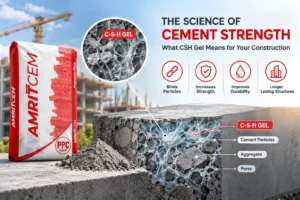
Using a Portland Pozzolana Cement like PPC can make a real difference. Amrit Cement’s PPC is a good example – the pozzolanic reaction will gradually fill in the tiny pores in the concrete matrix over time, cutting down on capillary rise. This is one of the major wall seepage causes in Indian construction.
2. Rising Damp from Groundwater
Rising damp is exactly as it sounds – water from the ground working its way up through the base of your walls.
It happens when there’s no proper DPC (damp proof course) at the plinth level, or when the DPC is damaged or laid out all wrong. In a lot of Indian residential construction, a DPC is a 20mm thick layer of cement mortar with a waterproofing compound slapped on at plinth height (about 150mm above the ground).
When that layer is missing or cracked, the groundwater just rises through the brick and mortar by capillary action. You’ll often see a tide mark – that’s the horizontal band of moisture and staining near the bottom of a wall, usually up to a metre high.
Rising damp is pretty common in:
- Older buildings that were built before BIS compliance was mandatory for DPC
- Buildings in low-lying areas with a high water table level (a big problem in parts of Assam and Bengal)
- Places where the plinth level is disturbingly close to the ground
3. Rainwater Penetration Through Walls and Roofs
India gets hit with a pretty hefty 1,170 mm of average annual rainfall across the board (India Meteorological Department, 2023). But in the Northeast, some states like Meghalaya are getting absolutely drenched – some of the highest rainfall in the world, that is.
When driving rain hits the outside of an external wall, water finds its way in through a few key weak spots:
- Cracks in the outer layer of plaster that just aren’t getting the job done\
- Crappy or missing weathering courses above windows and doors (basically a design flaw)\
- The joints between brickwork and window frames that were just kind of… ‘ forgotten’ when it came to sealing them up\
- Parapet walls on terraces that either don’t have a drip course or are just not sloped enough
That’s known as penetrating damp – as opposed to that other thing, rising damp, because it seeps in from the sides instead of pouring straight up. And these days, it’s the number one type of wall leakage problem to deal with in buildings that are two or three stories and up.
After every monsoon season, you tend to see patches showing up in the areas around windows, corners, or where the roof meets the building. These are the result of penetrating damp, not the usual condensation issues you might think they are.
4. Plumbing Leaks and Wet Area Seepage
Plumbing is often a major contributor to hidden wall leak causes in Indian homes, and yet it’s terribly underrated.
Leaks from pipes, water tanks, or other plumbing equipment seep into walls and slabs because pipes are tucked away inside the wall or running through the slab – so you might spot the damage a metre or two away from where the problem actually lies. And the worst part is that a slow drip can soak a 2 square metre patch of wall without ever actually dripping anywhere in plain sight.
Worst of all, bathrooms are the areas most prone to this sort of problem – and it’s usually because the waterproofing on the bathroom floors and walls was botched before the tile work was done. Water then sneaks through the grout lines and into the tile adhesive, leading to long term moisture issues in rooms either above or beside the bathroom.
Studies have found that in around 1 in 3 homes in Indian cities there’s a pretty good chance of your bathroom walls leaking fairly frequently within 5 years of being built – and this is usually because the waterproofing wasn’t done properly in the first place (Source: Construction Industry Development Council, India).
5. Condensation — A Silent Cause of Damage
So what happens when warm, humid air comes into contact with a cold wall surface ? Well basically the air temperature drops to the point where all the water vapour in the air turns into liquid on the wall – that’s condensation.
Here are some typical places to spot condensation in an Indian home:
- On north-facing walls that never get any direct sunlight
- In kitchens and bathrooms that are poorly ventilated
- In air-conditioned rooms where there’s a massive difference in temperatures between inside and outside
Unlike the other types of damp, condensation isn’t coming from the outside or from your plumbing – it’s coming from the water vapour inside your home. And the upshot is just the same as with other types of damp – black mould starts growing, paint starts peeling, walls get wet.
How to Stop Damp in Walls
Now we get to the part that really matters – how to stop damp walls once and for all.
Start With The Basics – Construction
The easiest and most cost-effective way to fix the problem is to prevent it from happening in the first place. Using high-quality materials right from the start – quality cement that’s up to scratch, a water-cement ratio that’s just right, and proper waterproofing compounds that pass the test – reduces the amount of moisture that can get through the concrete and plaster.
Amrit Cement’s PPC (Portland Pozzolana Cement) mixes fly ash-based pozzolans into its formula, which makes it super effective at keeping water out and at reducing damage over time. This makes it a top choice for plastering, masonry, and waterproofing jobs.
Waterproofing the Walls
For people who are stuck with damp walls in their existing homes – waterproofing walls can be done with:
- Cement-based waterproofing paint which is applied like regular paint to the internal and external surfaces – perfect for bathrooms, basements and those really tricky parapet walls on the terrace
- Acrylic waterproofing membranes which are super flexible and can be used for the exterior walls and terraces
- Crystalline waterproofing compounds which get added into the cement mix – they form crystals that plug up the tiny capillaries in the concrete and stop water getting through
- Injection grouting – this seals up active cracks in the concrete where you know water is coming in
Fix the DPC
If you’ve got a home that’s being slowly ruined by rising damp, it’s time to get down to business with some damp proofing work at plinth level. And let’s be clear – you’re going to need to sort out your plinth level damp proof course (DPC) if things get that bad. Fortunately, there is an option that can get the job done without the need for major demolition – and that’s the process known as a remedial DPC injection. Its the go to solution for a lot of older buildings that have been ravaged by rising damp – this is the standard way to fix it.
Do not Waterproof Over a Leak
When you’ve got damp walls, you might be tempted to seal them up and call it a day. But be warned – if you do that over an active leak in your plumbing system, you’ll just be covering the symptoms rather than the cause. If there’s a leak, track it down – use a pressure test on the supply pipes if you need to. Once you’ve dealt with the source of the problem, then and only then do you get around to fixing that dampness with a proper solution for damp walls.
How to Tackle Dampness Caused by Condensation
Condensation is a major culprit when it comes to dampness in homes. Here are some things you can do to tackle the problem:
- You need to make sure you’re getting proper ventilation going in your bathrooms and kitchens – get some exhaust fans fitted if you don’t already have them\
- If you’ve got rooms that are kept at a chilly temperature (because of the aircon), get some double glazing in to reduce the surface temperature a bit\
- Make sure you’re getting some cross-ventilation during the day to stop the air getting all still and stagnant\
- Finally, why not give anti-condensation paint a try on walls that are prone to the problem – this stuff has a thermal insulating layer built in
Frequently Asked Questions (FAQs)
Q1. What are the most common reasons for damp walls in Indian homes?
Poor quality construction materials really are a leading cause, not to mention the absence of a proper damp proof course (DPC). You also need to worry about water coming in through wall cracks from rain, bathroom and plumbing leaks, condensation, and roof waterproofing having failed.
Q2. How do you tell if its a plumbing leak or rising damp?
Rising damp tends to show up as a horizontal band right near the bottom of the wall (usually up to a metre high), with white salt stains (efflorescence) appearing. Leaks from pipes are generally a bit higher up the wall, close to the actual pipes, and the patch of moisture is often more random or even circular in shape. Sometimes getting a professional in for a damp survey is the best way to sort it out for sure.
Q3. Does the type of cement used really have an impact on dampness in walls?
The simple answer is yes – you get more moisture in walls if you’re using really low grade stuff or mixes that use too much water. And switching to PPC (Portland Pozzolana Cement) actually can make a big difference by cutting down on how much moisture gets in through the plaster and the concrete in the first place.
Q4. What is the best waterproofing method for bathroom walls?
The clear winner here is definitely applying a good cementitious waterproofing coating to all the walls and the floor before you start tiling. Make sure you cover the full floor area, all four walls right up to at least a metre high and all the pipes too. And when it comes to choosing a material, a flexible waterproofing compound (like a polymer-modified one) is always going to do a better job than a rigid one on its own.
Q5. How long do damp proofing treatments actually last for?
Chemical DPC injections can last anywhere from 20-25 years, which is good. But waterproofing coatings – either acrylic or cementitious – are a bit more iffy, lasting 5-10 years depending on the conditions and how well you look after them. Crystalline waterproofing, on the other hand, is basically permanent – once those crystals form in the concrete capillaries they become a part of the structure for good.
Fix the Cause, Not Just the Surface of Your Problem
Damp walls wont just magically sort themselves out – not even in a year, let alone two or three. Every time you delay tackling the issue, the water just keeps seeping deeper into the walls, the damage gets progressively worse, and before long the repair job is going to cost a small fortune.
The reasons damp walls occur in Indian homes are pretty straightforward really. You’ve got poor quality building materials, a DPC that’s been missed out, cracks appearing in the surface, a bathroom that’s leaking like a sieve, and water seeping in from the terrace all contributing to the majority of cases. And each one has a fairly obvious solution – whether it’s using decent cement when you’re building from scratch or proper damp proofing techniques for an existing place.
If you’re starting from scratch with a new build, then just get it right first time. Use a good quality cement that won’t let water seep in from day one. And if your place is already showing signs of water damage then don’t rush out to slap a surface treatment on – get a professional to take a proper look at the problem first.
At Amrit Cement, we’re all about giving Indian homes walls that stay strong and dry, through all the monsoons and all the seasons. So have a look at our range of PPC and OPC cements we’ve come up with to combat Indian conditions, and get in touch with one of our on-site experts who can give you some practical advice tailored to your region.