
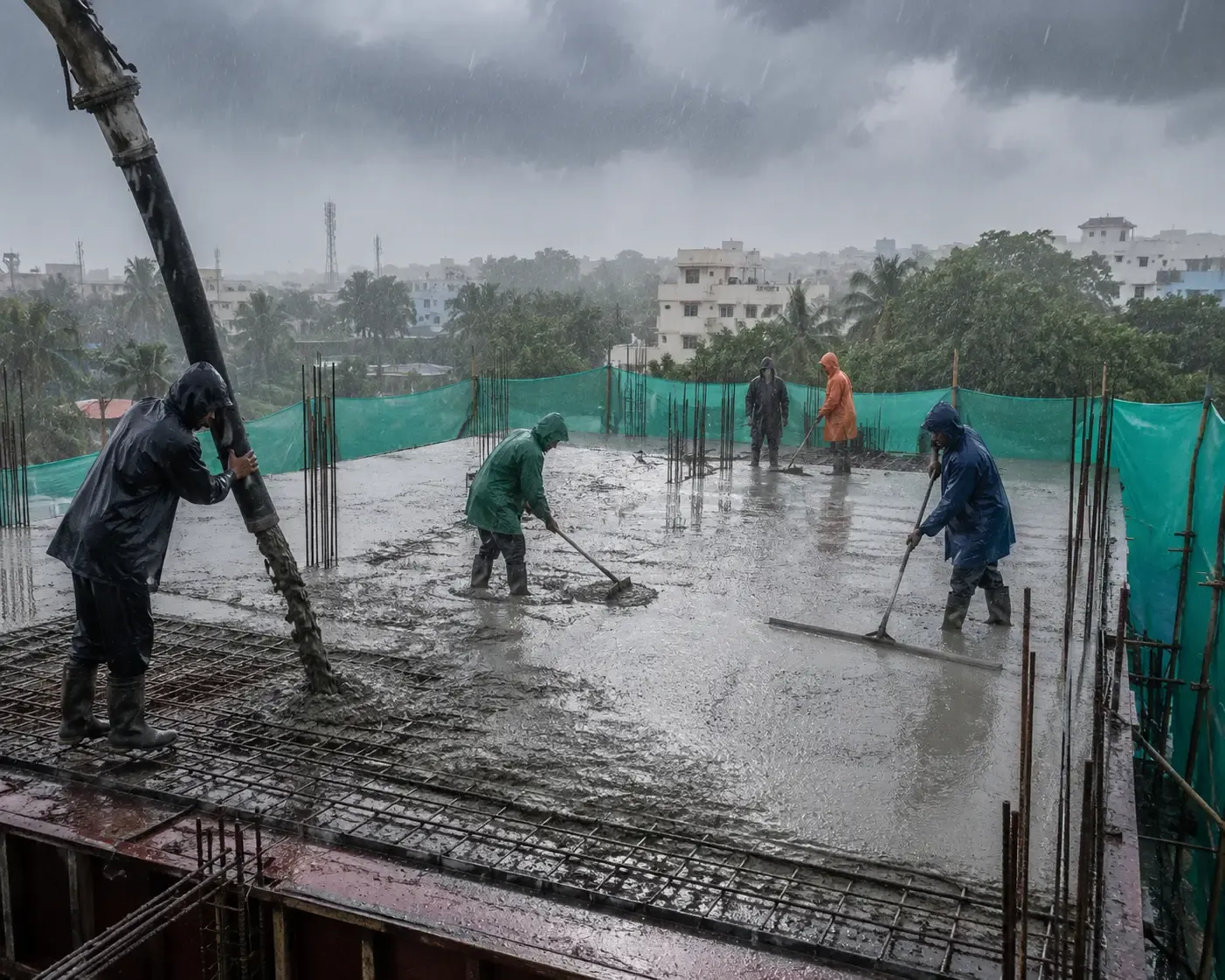
Every June, the same phone call happens at Amrit Cement’s technical helpdesk. A site engineer in Silchar or a contractor in Shillong asks the same question in a different way: “Sir, roof casting is scheduled for next week, but the forecast shows rain every day. Do we postpone, or do we go ahead?”
There’s no single right answer. But there is a right process. And that’s what this post is about.
Monsoon Doesn’t Wait for Your Schedule
In Northeast India, the construction calendar pretty much always clashes with the monsoon calendar. The two just dont go well together. Places like Assam and Meghalaya are among the wettest regions in the country and you see the impact of that in Cherrapunji and Mawsynram – those places see a whopping 10,000+ mm of rain every single year. Even the flatter parts of Assam get just as much – between 2 and 3 thousand mm – but it all comes down in just a few short months between May and September – we’re talking the whole works, not some light drizzle to just power through.
Builders really have no choice but to keep on schedule – their loan payments arent really going to voluntarily pause on their own and they cant just let their hired hands sit idle. The people who hired them are also counting on making progress, so even if the weather is nothing but rain, the roof casting – essentially the one most important pour in any house or small business building – still gets done, monsoon or not.
What Actually Goes Wrong
Here’s what makes monsoon concreting a challenge, in plain engineering terms – not exaggeration, just the facts.
- The water-cement ratio gets knocked askew. Concrete strength is highly dependent on a tightly controlled water-cement (w/c) ratio, which is usually kept between 0.4 and 0.5 for structural slabs. Every drop of rainwater that lands on wet, unset concrete is like throwing a wrench into the mix by adding uncontrolled water to that equation. Even a short10-15 minutedownpour on a freshly poured slab can push the w/c ratio up enough to reduce final compressive strength noticeably because excess water leaves unsightly capillary voids that will only show up later as the water evaporates.
- Segregation, courtesy of mess on the site. On manyNorth Eastsites, concrete is still hauled around in trolleys and chutes from the mixer to the roof. Rain makes the access ramps slippery and stirs up surface water which ends up getting mixed into the batch on the way – often separating the coarse aggregate from the cement paste before it even reaches the shuttering – which is exactly what you don’t want to happen.
- Rain can wreck the top layer before it even sets. Fresh concrete needs about 30 minutes to a few hours (depending on temperature and mix details) before it sets properly. Ifit’sexposed to rain during this time, that top layer – the layer that contains the reinforcement cover and finish level – is at risk of getting physically eroded, leaving behind pitting, exposed aggregate and uneven wear.
- Curing gets messed up. This isprobably themost common misunderstanding on site – contractors assuming “well, it’s raining so it’s curing on its own” – which isn’t the case. Curing under IS 456:2000 really means maintaining consistent moisture and temperature for at least 7 days, and up to 10-14 days in cases where blended cements are used. Intermittent rain followed by hot sun can create the exact kind of moisture cycling that curing is designed to prevent – not replicate.
- Waterlogged ground undermines the formwork and shuttering. Soft ground makes the props and shuttering stand onsink inwhen it gets waterlogged. A prop that sinks just 5-10 mm during the pour can end up creating a visible sag in the finished slab.
None of this means monsoon roof casting is impossible to do, it just means it needs a completely different level of prep than a dry-season pour. People who treat it the same way they’d treat a January pour are the ones who end up with cracked, honeycombed or under-strength slabs.
10 Best Practices for Monsoon Roof Casting
The practices listed below are recommended to dealers and site teams operating in Assam, Meghalaya, and Tripura, and are based on the IS code requirements as well as on what we’ve learned from experience on active sites during the June-September period
- Keep an eye on your forecast, day by day butstill keepan eye on the 48 hour window
Don’t just rely on the general forecast for monsoon season. Take a close look at the short term forecast 48 hours ahead of time and try to identify a bit of dry weather – a window of at least 6-8 hours for the pour itself, plus a little extra time to let the concrete set later. The local weather guys will be updating their bulletins and apps pretty regularly during monsoon time – try to get the updates in the morning rather than the night before.
- Cast your concrete early in the morning rather than in the afternoon
The monsoon pattern in NE India usually brings on the heavier rain later in the day, particularly down in the Brahmaputra valley & Meghalaya foothills. If you can get the pour done by 7 am, then your concrete has a good 4 hours or so of uninterrupted time to set before the heavy rain comes in.
- Have yourpolytanks& tarps on standby at all times
This might seem obvious, but it’s the one thing that tends to go wrong on delayed sites – the lack of a plan to keep your concrete slab dry. Make sure you have some decent tarps, some bamboo or pipe to keep them upright, and enough people to get the whole slab covered up within a couple of minutes of the first rain starts. A covered concrete slab is fine, an uncovered one is a disaster.
- Dumb down the water cement ratio for your mix
During a monsoon you’re already going to have high humidity hanging around, so it makes sense to maybe knock a tiny bit off the water cement ratio (but just a tiny bit, and only within the margins of your mix design – you dont want to kill the workability of the concrete). That way the concrete has a bit of a safety margin if some rain does get in during the placing & finishing process.
- Useready madeconcrete, or if you have to mix on site then protect it
If you can get your hands on pre-mixed ready concrete, that’s a big win – the batching is all being done in a controlled plant and the truck will have the right mix on it when it arrives. If you still have to mix on site then, at the very least make sure you have a good roof over the mixing area & the aggregate piles well before the pour is due to start, not just as an afterthought.
- Keep that cement and aggregate dry before the pour gets underway
Cement bags soak up moisture just by sitting there, even if they don’t get hit by rain. Especially in NE India where the humidity can be as high as 80-85% during the monsoon, this is a real concern. To put them in the best possible position, store those bags on wooden pallets at least a foot off the ground, keep them away from the outside walls and get to work on the pour within a few weeks of delivery. You can’t cut corners and expect a strong slab out of a monsoon pour – the difference in quality will be plain to see.
- Get that water flowing before the pour is cast,don’ttry to fix it afterwards
Rainwater pooling up around column bases and the props holding the formwork in place can weaken the ground and make the props sink in. Instead of trying to sort it out after the fact, dig temporary drainage channels around the working area the day before you cast – that way the rain has somewhere to go and you don’t have to worry about formwork getting waterlogged.
- Give that concrete the full curing time it deserves, rather than rushing it
Its tempting to just assume that because a slab got a good soaking from the rain, it must be fully cured by now. But don’t fall into this trap. Once the concrete has set (after 24-48 hours, depending on the conditions), start the proper curing process – whether that’s using wet hessian or proper ponding – and keep at it for at least 7 days – 10-14 if you’re using blended cement. Yes, monsoon humidity is great for retaining moisture, but it’s no substitute for actually putting in the effort to cure that concrete.
- Take cube samples and get them tested on every single monsoon pour, no matter what
Take standard 5-inch cube samples on every monsoon cast and send those off for strength testing – you want to know what you’re working with, after all. This isn’t some extra paperwork to deal with, it’s the only way to confirm that the slab has reached its design strength despite being cast in the rain. We’ve looked at the data from the sites we’ve worked on and it’s clear: slabs that followed these rules and were made despite the weather always came out strong; the ones that got compromised were usually due to ignoring one of these precautions, not the rain itself.
- Keep a spare team on standby to deal with the weather
A pour needs a dedicated team for laying down and finishing, and ideally a second team whose only job is keeping an eye on the weather and moving covers. With a slab the size of 1,000-1,500 square feet, that’s typically 4-6 extra workers you need to have on call for the duration of the pour and the next 24 hours. It’s an extra cost, but one you can’t afford to save on – a compromised roof is just not worth it.
A Quick Site Example
In a recent residential build in Nagaons district the roof pour dates coincided with the last week of july – peak monsoon season in the Brahmaputra valley . The site crew pushed the pour start to 6am, had 2 extra guys on tarp duty all day, and extended the cure time to 10 days as was needed because of the PPC cement used . They even ran the cube tests on this pour and amazingly they hit their 28 day target within the expected bracket as laid out in IS 456 . Now this was no accident, it was simply the result of following a checklist down the line and not skipping any of the steps just because “it’s raining”
The Takeaway
Roof casting during monsoon isn’t a gamble if it’s planned like a monsoon pour from day one — not like a dry-season pour that happens to get rained on. Forecast windows, timing, drainage, storage, and curing discipline matter more in these four months than at any other point in the build calendar.
At Amrit Cement, our technical team is available to walk dealers and site engineers through mix design adjustments and curing schedules for monsoon casting — because a roof is only as strong as the conditions it was cast under. Roof to Foundation Dhalai means getting every pour right, rain or shine.
Have a roof casting scheduled this monsoon? Reach out to your nearest Amrit Cement dealer for on-site guidance before you pour.