A structural engineer we work with in Guwahati says it in a nutshell : “Around the rest of India,you design for how heavy something is. Here, you design for how heavy its is, and how much water it’ll get, and how hard the ground will shake – all three, every single day.” That single sentence sums up pretty well why construction in Northeast India plays by a completely different set of rules compared to most of the country
This post takes a closer look at why the region is really quite a lot harder to build in than anywhere else, and what the numbers say about the unique problems its got, plus what the guys on site and the people building their own homes are doing differently to get things just right.
One Region, Three Compounding Challenges
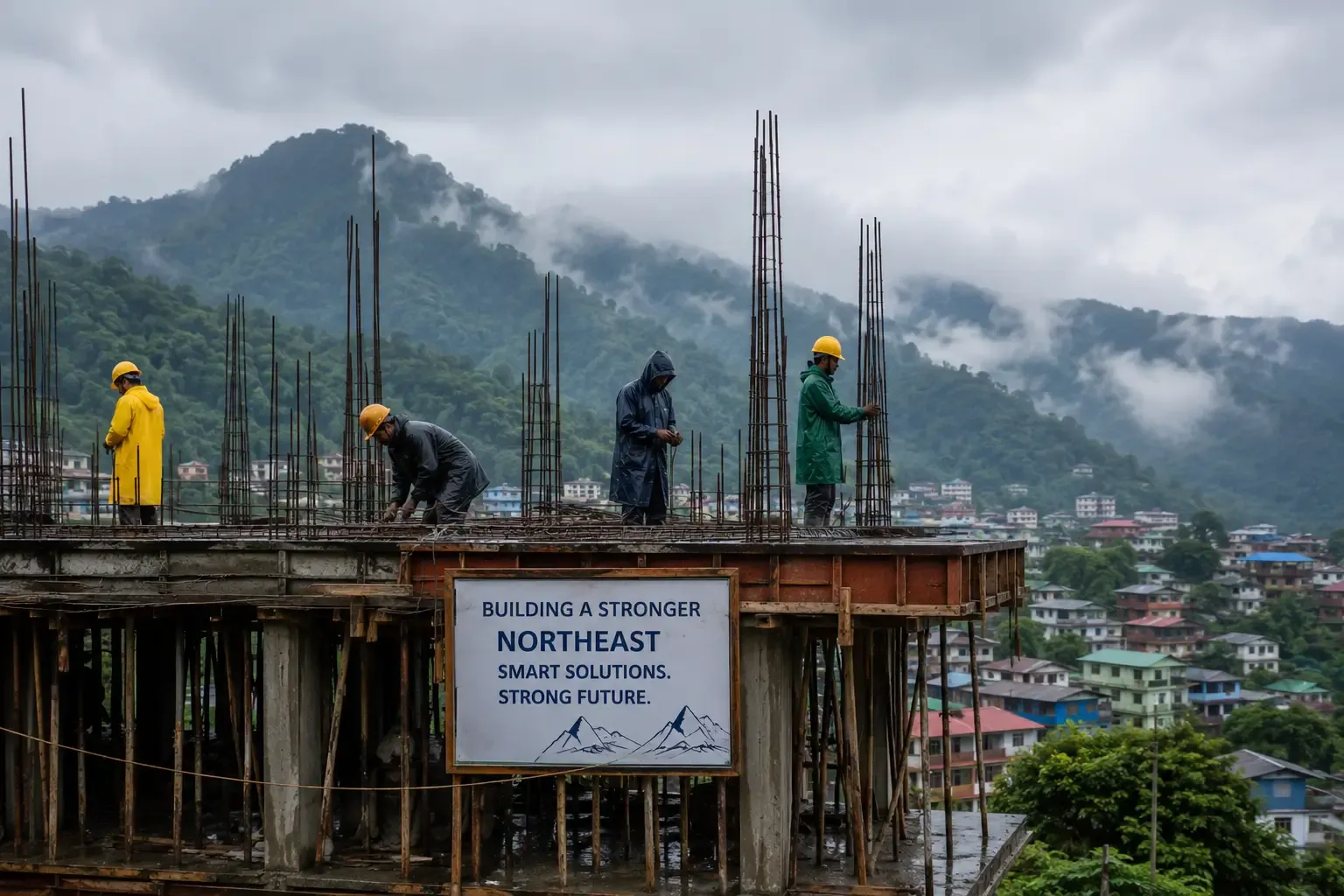
Building in Assam, Meghalaya, Tripura, Nagaland, Mizoram, Manipur, or Arunachal Pradesh means putting up with weather and geology that dont normally combine the way they do any other place in India.
Seismic risk is the highest in the whole country. Under the IS 1893:2016 building codes, almost all of Northeast falls in Seismic Zone V, the highest risk level that Indian building codes draw the line at. For instance, most of Delhi is in Zone IV and most of the southern part of the country is in Zone II or III. The Indian and Eurasian tectonic plates meet right here, and the 1950 Assam-Tibet earthquake (magnitude 8.6) one of the biggest on land ever recorded – not exactly a small event. That heritage , from way back when, goes a long way to determining how much extra reinforcement and detailing a warehouse or home needs.
Rainfall is longer than usual and wild. Meghalayas Mawsynram and Cherrapunji are top of the list for places on earth in terms of amount of rainfall – more than 10,000-11,000 mm per year. Even in the Brahmaputra and Barak valleys, away from the high peaks, you get 2,000-3,500 mm all falling in just four to five months between May and September. Thats months of rain which have to be factored into planning, curing times and just storing materials
The humidity stays put, almost the whole year. Relative humidity in Assam and Meghalaya often sits in a range of 75 -90% , even when its not raining much. Add in the heavy rain and you get a pretty constant wet environment for the buildings, foundations and stores to be in.
Now, on top of all that, there are the region’s unique terrain – steep hill slopes in Meghalaya, Mizoram, and Nagaland, and just generally soft ground in the Brahmaputra floodplain – and you can see why the standard national guidelines for building construction just dont cut it in this part of the country.
What Happens When the Region’s Conditions Are Ignored
These aren’t risks that we just theorize about, they turn up as very real damage when we just don’t factor them into the construction process
Cracking and spalling from moisture cycling. The problem is, concrete that gets a bad curing job or uses the wrong kind of cement for the humidity in the air, it starts to crack as it absorbs & releases moisture season after season. And if you just leave those cracks alone, water gets to the reinforcing steel and corroding rebar can swell up to several times its original size and start pushing the concrete apart from the inside.
Reduced structural performance in earthquakes. We always see the most damage from the ones that get built without Zone V detailing – basically, lousy column-beam connections, too much space between the stirrups, and subpar concrete grades. The 2021 Assam earthquake (that 6.4 thing near Sonitpur) really showed us that the older, non-engineered buildings took the brunt of the damage while the newer ones that were built to the book held up relatively okay.
Foundation settlement on floodplain soil. So most of the Brahmaputra valley sits on some pretty squishy soil thats been waterlogged for years and has no bearing capacity to speak of. And if you build a structure without doing any soil tests or designing the foundation for those conditions, you can bet its gonna sag and settle unevenly – just look for the walls tilting, doors jammed, and all those cracks radiating from the corners.
Material degradation from storage failures. Now cement is a bit of a sponge for moisture, even just sitting in an unopened bag in the humid air its gonna absorb some moisture over time and start to form lumps and lose its strength-giving properties. In a place where the humidity is never really below 70% like this is, cement stored all wrong – no pallets, no cover, no rotation – it just saps away its potency that much faster. And when you use that compromised cement you wont even notice at first, but eventually it’ll quietly bring down the final strength of whatever you poured it into.
Building Smart for Northeast India’s Conditions
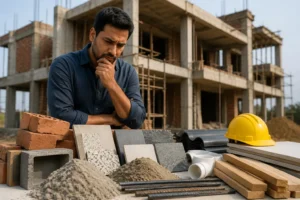
Construction in this region can’t be a lost cause – but you have to be smart about it from day one : the approach has to be tailored to the local conditions – the design, materials you use, and how you execute the build – all of it
- Don’t retro-fit Zone V – design for it from the start
Don’t leave structural design till afterwards – start with the right approach from the very beginning, even before the first drawing is done . Zone V in the IS 1893 and IS 13920 (ductile detailing) provisions needs to be in place from the get go. That means closer stirrup spacings on beam-column joints, enough lap lengths, and load distribution in the building plan that wont put too much stress on any one part.
- Pick cement that can handle the local weather
If you’re building in a humid, high-rainfall region, you want to avoid plain OPC – Blended cements like PPC and PSC are a better bet. They perform better in those conditions – they’ve got lower heat of hydration, reduced permeability, and are resistant to the kind of moisture cycling that comes with a lot of rain – which is why you see them widely used in local residential and infrastructure projects.
- Don’t skip the soil investigation – do it beforefinalisingyour foundation design
In areas like the Brahmaputra and Barak valleys , soil bearing capacity can change from one plot to the next – even within the same plot. If you don’t do a geotechnical investigation before designing your foundations, you might end up with the kind of differential settlement that can be a real problem for any new build.
- Plan your construction schedule around monsoons
Major pours of concrete (like foundations, columns and slabs ) need to be timed with the monsoon in mind – that means early morning starts, having tarpaulin covers ready in case of rain, and making sure that curing periods are long enough to account for all the moisture that comes with the rain and sun – and that’s anything from 7 days for OPC to 10-14 days for blended cements, as laid out in the IS 456:2000.
- Store cement properly, anddontstockpile it for months
Cement bags need to be kept off the ground, on a raised wooden pallet, covered and at least 15-20 cm away from the outside walls, and used within a few weeks of delivery. That simple routine will prevent most of the strength loss that comes with stockpiling in a humid region
- Give your roofs and site a good slope and drainage
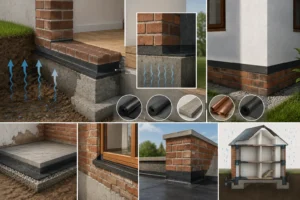
You dont want flat surfaces collecting water in this region – that’s just a water trap waiting to happen. Roofs, terraces and site grading all need to be designed to have more than enough drainage capacity for all that rain.
- Go for corrosion resistant rebar in high-moisture areas
If your building is close to a river, or in a low-lying area with a lot of groundwater, or any other spot with high humidity, using coated or corrosion resistant rebar will make a big difference. Combine that with good concrete cover and the structure will last longer – especially against the effects of corrosion.
A Site Example from the Brahmaputra Valley
On a residential project in Nagaon the design team had the sense to run a soil test before settling on the foundation and were shocked to discover the bearing capacity was a worrying 20% lower than the estimates they had based their design on for an adjacent building a few years ago, built in a similar area. Its a building a few years older. So they took that into consideration and the foundation design got adjusted before construction even got underway – wider footings and a slightly deeper foundation. You know the rest because they also used PPC cement for the superstructure and gave the columns the Zone V detailing. And then in 2021 we had the Sonitpur earthquake take the Brahmaputra valley by storm – and this building didn’t suffer one bit of noticeable structural damage – which is a big plus. In the same area a bunch of older buildings, built without engineers, were sporting plaster cracks and in a few cases even cracked structurally. The difference in the end wasnt how the building reacted to the quake itself but what had gone on during the design and materials phase.
Why Cement Selection Matters More Here Than Elsewhere
Look, lets not beat around the bush. In most of India when making a choice between different types of cement its usually a case of weighing up the price tag and how long it takes to set. But in North East India its a whole different ball game – here its not just about the cost or how long it takes to set. Its about a building thats going to have to last in an environment that’s actively working against it 24/7 – 365 days a year. So with the combination of high humidity, constant rainfall and regular seismic activity you start to see why engineers and contractors are increasingly favouring special cements that are blended to withstand this sort of environment. Ones that wont turn to mush in the wet, and hold up to all the moisture.
The Takeaway
Construction in Northeast India isn’t harder because of poor planning by builders — it’s harder because the region combines seismic risk, extreme rainfall, and near-constant humidity in a way few other parts of the country do. The projects that hold up over decades are the ones where design, material selection, and execution all account for that combination from the start, not the ones that treat local conditions as an inconvenience to work around.
At Amrit Cement, our formulations and technical guidance are built around exactly these regional realities — because a structure in the Brahmaputra valley or the Khasi hills needs to be engineered for what the region actually throws at it. Roof to Foundation Dhalai, built for the Northeast, by people who build here.
Planning a construction project in the region? Talk to your nearest Amrit Cement dealer about the right cement grade and mix for your site conditions.