The Costliest Mistake in Construction Often Happens Before Construction Begins
Most homeowners spend weeks comparing cement brands. Very few spend even an hour calculating how much cement they actually need.
That is where the first mistake usually happens.
Buy too little, and work stops halfway.
Buy too much, and unused cement may sit on site until moisture slowly damages it.
Neither is good for your budget. A good house doesn’t begin with pouring concrete. It begins with a good construction material estimate. And the first material on that list is usually cement.
Why Cement Quantity Calculation Matters
Think of your house as a collection of smaller projects.
A foundation.
Brick walls.
Columns.
Roof slabs.
Plaster.
Flooring.
Each one consumes cement differently.
That is why there is no single answer to the question,
“How much cement for construction?”
It depends on:
- The size of your house.
- The type of work being done.
- The concrete or mortar mix.
- The thickness of plaster.
- The number of structural elements.
A proper cement quantity calculation helps you:
- Plan your budget more accurately.
- Reduce material wastage.
- Avoid unnecessary site delays.
- Purchase cement in stages instead of guessing.
A little planning today saves a lot of correction tomorrow.
Step 1: Know Where Cement Will Be Used
Before you start calculating, make a list of every activity that requires cement.
For most homes, that includes:
- Foundations.
- Columns and beams.
- Roof slabs.
- Brick masonry.
- Plastering.
- Flooring.
- Staircases.
- Small repair and finishing works.
Many homeowners calculate only the concrete.
Then they realise they forgot plaster and masonry.
The estimate suddenly changes.
The better approach is to calculate every activity separately and then combine the total.
Step 2: Calculate the Volume of Work
Every quantity calculation begins with one thing.
Volume.
Fortunately, the basic formula is simple.
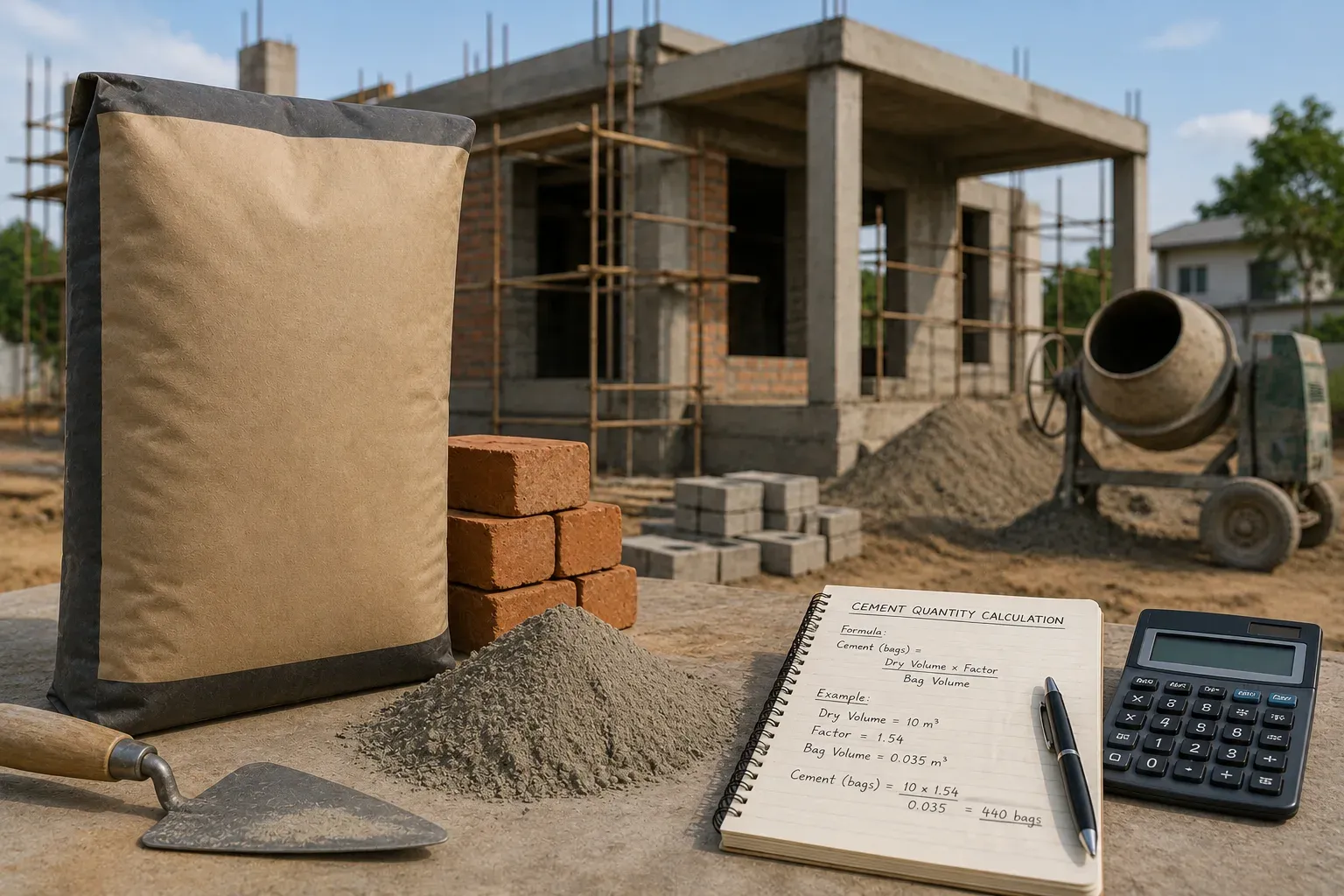
Volume = Length × Width × Thickness (or Height)
Once you know the dimensions of the work, you can estimate the quantity of concrete or mortar required.
For example:
Suppose you are casting a roof slab measuring:
- Length = 10 metres
- Width = 8 metres
- Thickness = 0.125 metre (125 mm)
The concrete volume becomes:
10 × 8 × 0.125 = 10 cubic metres
This is the starting point for calculating cement.
Without the volume, every estimate becomes guesswork.
Step 3: Understand the Concrete or Mortar Mix
Knowing the volume isn’t enough.
You also need to know the mix.
Different construction work uses different proportions.
Some common examples include:
| Construction Work | Typical Mix* |
|---|---|
| PCC | 1:3:6 or 1:4:8 |
| RCC | 1:1.5:3 or design mix |
| Brick masonry mortar | 1:6 |
| Internal plaster | 1:4 or 1:6 |
| External plaster | As specified by the engineer |
*Actual mix proportions should always follow the structural engineer’s design or project specifications.
The richer the mix, the more cement it generally requires.
This is why two houses of the same size may consume different quantities of cement.
Step 4: Estimate the Number of Cement Bags
Once the volume and mix are known, estimating cement becomes much easier.
Most engineers and contractors use standard estimation tables or approved calculation methods to convert concrete or mortar volume into the required number of cement bags.
For homeowners, the simplest approach is not to memorise formulas.
It is to use a reliable cement cost calculator or ask your engineer for the estimated cement consumption for each activity.
What matters most is that the estimate is based on actual drawings—not assumptions.
Cement Consumption Varies Across Different Construction Activities
One mistake many homeowners make is expecting cement usage to remain the same everywhere.
It doesn’t.
A roof slab generally consumes much more cement than a brick wall.
Brick masonry consumes cement differently from plaster.
Flooring has its own requirements.
Instead of asking,
“How many cement bags does my house need?”
Ask,
“How many bags does each stage of construction need?”
That one change makes your estimate far more accurate.
Don’t Forget Wastage
Every construction project experiences some material loss.
Small spills.
Handling losses.
Uneven surfaces.
Leftover mortar.
Site adjustments.
That is why contractors usually keep a small allowance while preparing a construction material estimate.
The objective isn’t to overbuy.
It is to avoid running short when work is in progress.
Ordering one extra truck because of poor estimation often costs much more than careful planning.
Common Mistakes During Cement Quantity Calculation
Most estimation errors are surprisingly simple.
Avoid these common mistakes:
- Calculating only concrete and forgetting masonry or plaster.
- Measuring dimensions incorrectly.
- Ignoring wall openings while estimating plaster.
- Assuming every construction activity uses the same cement quantity.
- Buying all the cement at once instead of planning purchases stage by stage.
- Ignoring normal site wastage.
Accurate estimation isn’t about complicated mathematics.
It is about paying attention to details.
Why Engineers Rarely Guess
Ask an experienced engineer how much cement your house will require.
They probably won’t answer immediately.
Instead, they’ll ask for:
- Structural drawings.
- Architectural drawings.
- Concrete grades.
- Mortar specifications.
- Plaster thickness.
They know that accurate estimates come from information.
Not experience alone.
That is exactly why a proper cement quantity calculation is always more reliable than rough assumptions.
A Cement Cost Calculator Makes Planning Easier
Today’s homeowners don’t have to estimate everything manually.
A reliable cement cost calculator can provide a quick estimate based on your project dimensions and construction activity.
It won’t replace a structural engineer.
But it gives you a realistic starting point for budgeting and material planning.
Use it to understand the approximate requirement.
Then verify the final quantity with your contractor or engineer before placing the order.
That combination works best.
Why Builders Choose Amrit Cement
Whether you need 50 bags or 500, consistency matters.
Every bag should perform the same way.
That is exactly what contractors expect from Amrit Cement.
Its consistent quality helps builders maintain reliable concrete and mortar mixes across foundations, masonry, plastering and structural work.
When your estimate is accurate and your cement performs consistently, planning becomes much easier.
And so does construction.
Build Your Estimate Before You Build Your House
People often believe construction begins on the day excavation starts.
Actually, it begins much earlier.
With measurements. Calculations. Drawings. Material planning.
A good construction material estimate doesn’t just tell you how much cement to buy.
It helps control costs, reduce waste and keep your project moving without unnecessary interruptions.
So before asking,
“Which cement should I buy?”
Ask one more question.
“How much cement do I actually need?”
That answer could save you far more than you expect.