A Cement Shop Can Make a Simple Question Complicated Very Quickly
You walk in and ask for cement. The dealer asks which one.
OPC?
43 or 53?
PPC?
PSC?
Suddenly, buying cement sounds like buying something considerably more technical than a grey powder in a bag. And it should.
Because a foundation, precast element, plastered wall and marine structure do not ask the same thing from cement. Some projects need early strength. Some need lower heat generation. Some spend their lives fighting moisture or aggressive chemicals. Some simply need reliable cement for everyday masonry and plastering.
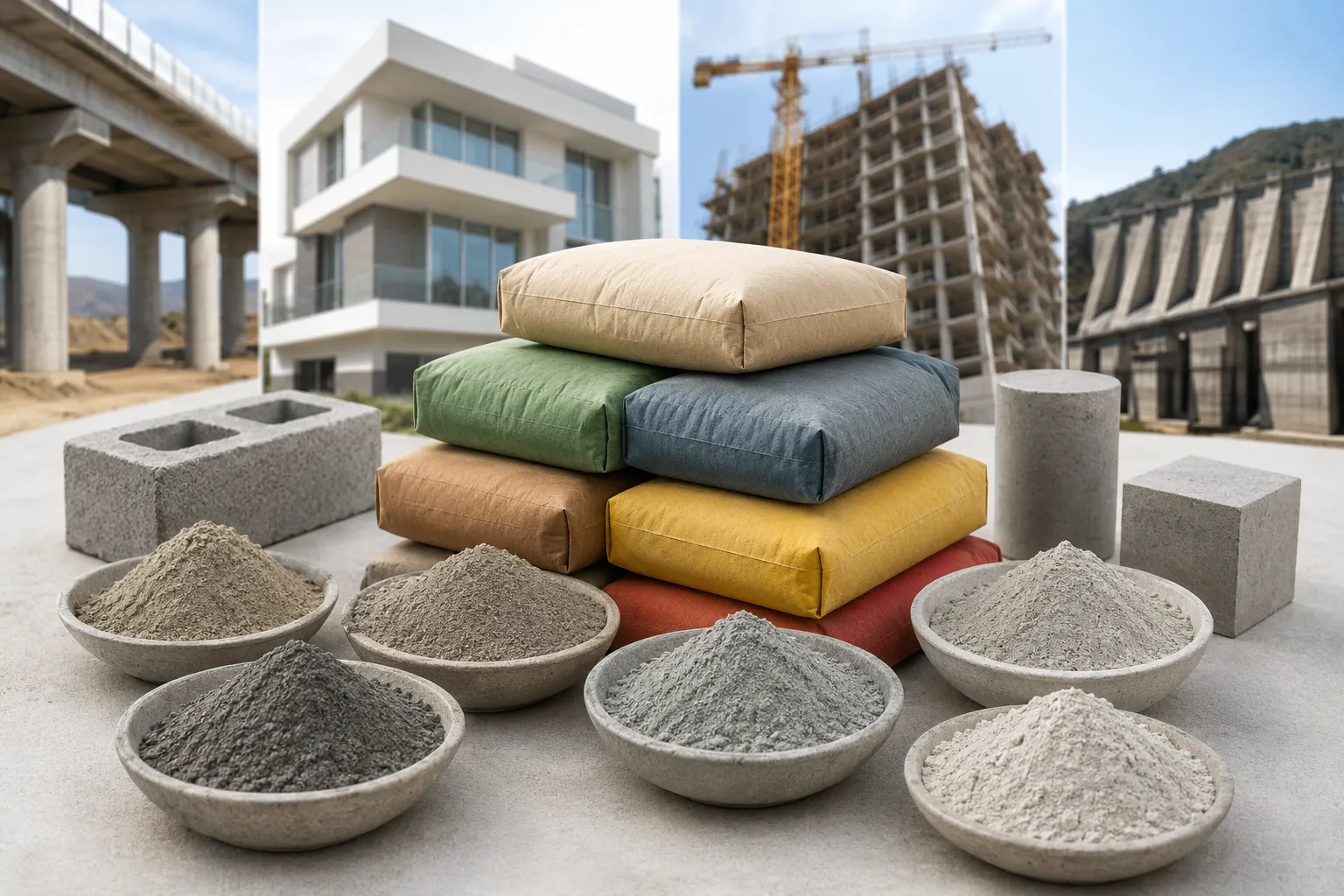
That is why there are different Types of Cement.
Not to make construction complicated. To give engineers the right material for different jobs. Let’s make those choices easier to understand.
Start With the Three Names You Will Hear Most Often
For most homeowners and ordinary construction buyers in India, three cement types in India are particularly useful to understand:
OPC – Ordinary Portland Cement
PPC – Portland Pozzolana Cement
PSC – Portland Slag Cement
They are not simply three versions of the same product. Their composition and performance characteristics differ, which makes each useful for particular construction requirements.
Here is the short version.
| Cement Type | Particularly Known For | Common Applications |
|---|---|---|
| OPC | Faster strength development | RCC, precast and general structural work |
| PPC | Durability, lower heat and good workability | Homes, foundations, masonry, plastering, RCC |
| PSC | Durability in aggressive exposure | Marine, coastal, sewage and durability-focused structures |
Now, the useful version.
1. OPC: When Early Strength Matters
OPC cement, or Ordinary Portland Cement, is the cement most people associate with conventional concrete construction. In India, OPC is covered by IS 269 and is available in 33, 43 and 53 grades. The grade number refers to the minimum compressive strength of the standard cement mortar at 28 days, expressed in MPa. So OPC 53 has a higher specified 28-day strength than OPC 43. But this is where people often make the wrong jump.
53 does not mean “best cement for everything.”
OPC 53 is particularly useful where higher early strength is valuable. It is commonly considered for RCC, precast concrete, prestressed work and projects with faster construction cycles, subject to the engineer’s design.
OPC 43 can serve general construction and structural applications where its strength characteristics suit the requirement.
OPC also generally develops more heat during hydration than blended cements such as PPC. For a small structural member, that may be manageable. For large concrete pours, heat development becomes a much bigger engineering conversation.
2. PPC: When the Building Has a Long Life Ahead of It
PPC takes Portland cement clinker and combines it with pozzolanic material, commonly fly ash in India. That changes what happens inside the concrete.
When cement hydrates, it produces calcium silicate hydrate, or C-S-H, which provides much of concrete’s binding strength. It also produces calcium hydroxide.
The pozzolanic material in PPC reacts with that calcium hydroxide over time and forms additional cementitious compounds.
In simple language?
The concrete can continue developing a denser internal structure. That is one reason PPC cement is associated with good long-term durability, lower permeability and comparatively lower heat of hydration.
It is widely used for:
- Residential construction
- Foundations
- RCC where specifications permit
- Masonry
- Plastering
- Hydraulic structures
- Mass concrete
It also offers good workability, which makes it useful for mortar and plaster.
The trade-off is worth understanding. PPC generally develops early strength more gradually than high-early-strength OPC. So, if a project needs rapid formwork cycling or very specific early-age strength, the engineer needs to account for that. PPC is not slow because it is poor cement. It simply develops differently.
3. PSC: Cement That Likes Difficult Environments
Now imagine concrete that spends decades near seawater. Or wastewater. Or soil containing aggressive chemicals. That is a different job altogether.
PSC cement, or Portland Slag Cement, contains granulated blast-furnace slag along with Portland cement constituents. Its characteristics can help produce concrete with lower permeability and good resistance to certain aggressive environments when properly designed and cured. That makes PSC particularly useful in applications such as:
- Marine construction
- Coastal structures
- Sewage works
- Foundations in certain aggressive soils
- Water-retaining structures
- Large infrastructure projects
In India, PSC is covered by IS 455.
Does that mean every house needs PSC?
No.
It means PSC becomes particularly valuable when the exposure conditions give you a reason to choose it. That distinction matters throughout cement selection.
Then There Are Cements Made for Very Specific Problems
OPC, PPC and PSC cover a large part of ordinary construction needs. But modern construction occasionally asks unusual questions. The cement industry has answers for those too.
4. Sulphate Resisting Portland Cement
Some soils and groundwater contain sulphates. When sulphates penetrate unsuitable concrete, they can participate in reactions that cause expansion and deterioration.
Sulphate Resisting Portland Cement (SRPC) is formulated with controlled composition to improve resistance to sulphate attack.
It may be specified for foundations, underground structures, sewage works and other projects exposed to significant sulphate conditions.
But don’t diagnose the soil by looking at it. Where chemical exposure is a concern, testing and engineering assessment should guide the cement selection.
5. Composite Cement
This is one of the modern cement types homeowners may hear about more frequently. Composite cement uses more than one supplementary cementitious material along with Portland clinker. In India, composite cement is covered under IS 16415.
Why combine materials?
Because different constituents can complement one another and allow concrete to achieve useful durability characteristics while reducing the proportion of clinker in the cement. Its suitability still depends on the application and project specification. Modern does not mean universal.
6. White Cement
White cement does not usually enter the conversation when someone is casting a conventional RCC column. Its job is different. It is manufactured to achieve high whiteness and is commonly used for architectural and decorative applications such as:
- Wall finishes
- Tile-related applications
- Decorative concrete
- Terrazzo
- Architectural elements
Think of it as a specialised finishing material rather than the default structural cement for construction.
7. Hydrophobic Cement
There is an interesting problem with cement. It does not particularly enjoy moisture before you use it. In areas involving prolonged storage or transportation under humid conditions, hydrophobic cement can be useful. Water-repellent substances are incorporated to help protect cement particles against moisture during storage.
This doesn’t mean concrete made from it suddenly needs no waterproofing. Hydrophobic protection during storage and waterproofing a finished building are two completely different things.
Same word. Very different job.
What About Rapid-Hardening and Low-Heat Cement?
You may also come across these terms in construction literature.
Rapid-hardening cement is designed to develop strength more quickly and can be useful where early removal of formwork, road repairs or faster construction is required.
Low-heat cement is intended to limit heat generated during hydration, which is valuable in large mass-concrete structures where excessive temperature differences can contribute to thermal cracking.
These are specialised requirements. For an ordinary homeowner, the important lesson isn’t to memorise every cement name. It is to understand why these cements exist. Construction problems differ. So, cement performance differs too.
Which Cement Should You Actually Use?
Here is a more useful way of looking at the choice:
| Your Requirement | Cement Commonly Considered* |
|---|---|
| Fast early-strength structural work | OPC 53 |
| General RCC | OPC/PPC as designed |
| Foundation | PPC/PSC/OPC depending on exposure and design |
| Brick or block masonry | PPC/OPC 43 |
| Plastering | PPC/OPC 43 |
| Mass concrete | PPC or other lower-heat system |
| Marine/coastal exposure | PSC or other exposure-suitable cement |
| Significant sulphate exposure | Sulphate-resistant system as specified |
| Decorative work | White cement |
*Actual selection should follow the structural engineer, exposure conditions, concrete mix design and applicable Indian Standards.
Don’t Choose Cement by Grade Alone
If there is one habit worth leaving behind, it is this:
Higher number = better cement.
Construction is more intelligent than that. A high-early-strength cement can be excellent for one application and unnecessary for another. PPC can develop strength more gradually but offer valuable long-term durability characteristics. PSC can become particularly useful when aggressive exposure is the problem.
The correct question is therefore not:
“Which is the strongest cement?”
Ask:
“What does this part of my building need?”
Early strength?
Long-term durability?
Lower heat?
Chemical resistance?
Workability?
Exposure protection?
Once that is clear, choosing between the Types of Cement becomes much easier.
Where Amrit Cement Fits Into Everyday Construction
For most residential builders, the cement conversation will commonly come down to OPC and PPC. Amrit Cement offers cement options designed for different construction requirements, allowing the selection to be made according to structural specifications and application.
Where faster early strength is important, an appropriate OPC can be considered.
Where workability, long-term durability and lower heat development are important, PPC can be a practical choice for suitable foundations, RCC, masonry and plastering applications.
But whichever cement you choose, use genuine, properly stored stock and follow the specified mix, water-cement ratio, compaction and curing.
Good cement still needs good construction. Always.
You Don’t Need to Remember Every Type. Remember Why You Need It.
That is probably the easiest way to understand cement types in India. OPC exists because some construction needs reliable strength development, including high early strength where specified.
PPC brings pozzolanic characteristics that can support durability and lower permeability. PSC becomes valuable when aggressive exposure demands more from concrete. Special cements exist because specialised projects create specialised problems. So don’t walk into the cement shop and ask for the “best cement.” There is no useful answer to that question without knowing the job.
Tell the engineer what you are building. Understand what that part of the structure will face. Then choose the cement whose properties answer that problem. The bag may look almost identical. What happens after you mix it with water can be very different.
Frequently Asked Questions
What are the main types of cement used in India?
Common Types of Cement include OPC, PPC and PSC. Special-purpose products such as sulphate-resisting cement, composite cement and white cement are used where particular construction or exposure requirements apply.
What is the difference between OPC and PPC cement?
OPC generally offers faster early-strength development. PPC contains pozzolanic material such as fly ash and generally develops strength more gradually while offering benefits such as lower heat of hydration and good long-term durability.
What is PSC cement used for?
PSC is particularly useful for durability-focused construction and structures exposed to marine, coastal or certain chemically aggressive conditions, subject to project specifications.
Is OPC 53 always better than OPC 43?
No. OPC 53 has a higher specified compressive strength and is useful where higher early strength is needed. OPC 43 may be entirely suitable for applications where that higher early-strength performance is unnecessary.
Which cement is best for house construction?
There is no single cement type that is automatically best for every part of a house. PPC and OPC are both widely used. Selection should depend on the application, structural design, exposure conditions and required strength-development schedule.
Can PPC be used for RCC?
Yes. PPC can be used for RCC where permitted by the structural specification and concrete mix design. The required strength at different ages and construction schedule should be considered.