
The Same House Can Need Different Things From Cement. Your foundation spends its entire life underground. Your walls spend theirs holding masonry together and taking plaster. Your roof slab sits at the top, taking structural loads, summer heat and years of rain.
Three parts of the same house.
Three very different working conditions.
Yet cement is often purchased with one instruction:
“Give me the strongest one.”
That sounds sensible. It isn’t always.
The Best Cement Grade is not necessarily the cement with the largest number printed on the bag. It is the cement whose strength development, durability and working characteristics suit the job being done.
So, instead of ranking OPC 43, OPC 53 and PPC from good to better to best, let us walk through an actual house and see what each part really needs.
Before Choosing a Grade, Know What 43 and 53 Actually Mean
OPC 43 and OPC 53 are grades of Ordinary Portland Cement. Under Indian Standards, the grade indicates the minimum compressive strength achieved by standard cement mortar specimens at 28 days. In simple terms:
| Cement | Minimum 28-Day Compressive Strength |
|---|---|
| OPC 43 | 43 MPa |
| OPC 53 | 53 MPa |
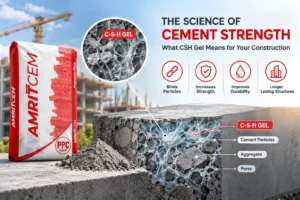
This does not mean concrete made with OPC 53 will automatically be stronger than concrete made with OPC 43. Concrete strength also depends on its mix design, water-cement ratio, aggregate quality, batching, compaction and curing.
And PPC?
PPC does not carry a 43 or 53 grade designation. Portland Pozzolana Cement is a different cement category, generally selected for characteristics such as long-term durability, comparatively lower heat of hydration and good workability. That clears up the first confusion. Now we can build.
Start Underground: What Should the Foundation Get?
A foundation has two important jobs.
- Carry the building safely.
- And continue doing so while sitting in or close to soil for decades.
Depending on the site, that may mean exposure to ground moisture, groundwater and chemically aggressive soil. So, when selecting a cement grade for foundation, early strength should not be your only consideration. Long-term durability matters enormously.
Where PPC makes sense
PPC is widely used for foundation work because its pozzolanic reaction continues contributing to the concrete microstructure over time. Properly designed and cured PPC concrete can develop lower permeability and good long-term durability.
It also generally generates less heat during hydration than OPC, which can become useful in larger foundation pours.
Where OPC may make sense
OPC can be specified when the project requires faster early-strength development or when the structural engineer has designed the concrete around a particular OPC grade. There is another condition.
If soil or groundwater contains significant sulphates or other aggressive substances, don’t choose cement from a general table. Get the exposure assessed. The ground beneath your house deserves a more specific answer.
Now the RCC Frame Starts Rising
Columns and beams are different. Here, strength requirements and construction speed become much more important. This is where OPC 53 frequently enters the conversation.
Its higher early-strength development can be useful for RCC and other structural work where the mix design and construction programme require it. But this does not create a rule that says:
Column = OPC 53.
PPC can also be used in RCC where the engineer’s design, required concrete strength and construction schedule permit it. The important number for your column is not simply the cement grade. It is the concrete grade specified in the structural design.
M25 concrete, for example, does not mean someone simply opens a bag of 53-grade cement and automatically gets M25.
The concrete has to be designed and produced to achieve its specified performance. That distinction can prevent a lot of bad construction advice.
Then Come the Walls. And They Ask for Something Else.
A brick wall isn’t a column. It does not need mortar selected merely for rapid early strength. Masonry mortar needs to be workable enough to spread properly, bond masonry units and fill joints consistently. That makes PPC and OPC 43 practical choices for cement for walls, depending on the specified mortar.
PPC’s workability makes it particularly useful for masonry and plastering applications.
OPC 43 is also suitable for many general construction and masonry applications.
Would OPC 53 work?
It can be used where appropriately specified. But using it simply because 53 sounds stronger may offer no useful advantage for ordinary wall masonry. Your mason needs a good mortar. Not a cement-grade competition.
Plaster Changes the Question Again
Now the cement is no longer buried inside a large structural member. It is being spread as a comparatively thin layer over your walls.
Here you want:
- Good workability.
- Good adhesion.
- A cohesive mix.
- A suitable finish.
- Controlled cracking.
PPC is widely used for plastering because of its workability and gradual strength development. OPC 43 can also be used where specified. But cement is only one ingredient.
Poorly graded sand, excess water, incorrect mortar proportions, inadequate surface preparation or bad curing can ruin plaster made with perfectly good cement.
If plaster cracks, changing the brand on the next bag without finding the actual cause is not much of a repair strategy.
The Roof Has a More Complicated Life
Now we reach the top of the house. Your RCC roof slab has to carry its designed loads. But that isn’t all. It also faces environmental exposure.
Hot afternoons.
Cool nights.
Rain.
Repeated wetting and drying.
And, if drainage is poor, standing water.
So, the cement for roof slab needs to be considered alongside durability, concrete permeability, cracking, curing and waterproofing.
PPC for roof slabs
PPC can be suitable for residential roof slabs where the structural design permits it. Its comparatively lower heat of hydration and long-term pozzolanic reaction can be useful in durability-focused concrete.
OPC 53 for roof slabs
OPC 53 may be preferred where higher early strength is required, for example when construction schedules demand faster strength development. Neither gives you permission to neglect the roof afterwards.
Correct water-cement ratio.
Proper compaction.
Adequate curing.
Correct slope.
Drainage.
Waterproofing where specified.
All still matter.
There is no cement grade capable of making rainwater flow uphill towards a badly positioned drain.
OPC vs PPC Cement: Decide by Priority, Not Popularity
Here is a simpler way to understand the OPC vs PPC cement decision.
| If Your Priority Is… | What May Be Considered |
|---|---|
| Higher early strength | OPC 53 |
| General-purpose OPC performance | OPC 43 |
| Long-term durability | PPC |
| Lower heat development | PPC |
| Masonry workability | PPC / OPC 43 |
| Plastering | PPC / OPC 43 |
| Fast construction cycle | OPC 53 where specified |
| Durability-focused RCC | PPC where design permits |
There is no winner here. There shouldn’t be. If every cement solved exactly the same problem in exactly the same way, we wouldn’t need different types in the first place.
A Practical Cement Plan for a Typical House
For a homeowner trying to simplify all of this, the selection may broadly look like this:
Foundation: PPC can be a strong durability-focused choice; use engineer-specified OPC where early strength or other requirements call for it.
Columns and beams: OPC 53 is commonly considered where higher early strength is useful; PPC can also be used according to structural design.
Brick/block masonry: PPC or OPC 43.
Internal and external plaster: PPC or OPC 43.
RCC roof slab: PPC for durability-focused construction or OPC as required by the structural design and construction schedule.
This is guidance. Not a substitute for the structural specification.
Because the best cement for house construction is ultimately the cement that works with the designed concrete and the conditions your particular house will face.
Q. What About Using PPC Throughout the House?
For many residential projects, PPC can indeed be used across several stages.
Foundation.
RCC.
Masonry.
Plaster.
Roof slab.
Its workability, lower heat development and long-term durability characteristics make it versatile. But there may be parts of the project where faster early-strength development is important. That is where an engineer may specify OPC.
So rather than asking:
“Can I build the entire house with one cement?”
Ask:
“Would changing the cement at any stage give this part of the house a useful performance advantage?”
That is a much better construction question.
Where Amrit Cement Fits Into the Choice
Amrit Cement offers OPC and PPC options for different construction requirements.
For applications where faster early-strength development is required, the appropriate Amrit OPC can be selected according to the project specification.
For residential work where durability, workability and long-term performance are important, Amrit Cement PPC can be considered across suitable foundation, RCC, masonry, plastering and roof applications.
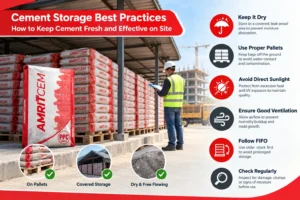
The decision should still be supported by the engineer’s specification. And once the cement reaches the site,
protect it.
Store bags away from moisture.
Use the specified mix.
Do not add unnecessary water.
Compact concrete properly. And cure it properly. Because choosing the right cement is only the beginning of getting the concrete right.
Don’t Ask Which Cement Is Strongest. Ask What You Need It to Be Strong At.
That small change makes the Best Cement Grade much easier to choose. Your foundation needs durability in an environment your walls will never see. Your RCC frame needs designed structural performance. Your masonry needs workable mortar. Your plaster needs good application characteristics. Your roof needs structural strength and long-term resistance to environmental exposure.
Different jobs.
Different priorities.
So OPC 53 isn’t automatically better because 53 is bigger than 43.
And PPC isn’t automatically better simply because it offers durability advantages.
The best cement is the one selected for the work in front of it. Because a house isn’t one concrete element. It is hundreds of construction decisions stacked on top of one another. The right cement should change when the reason for choosing it changes.
Frequently Asked Questions
Q. Which is the Best Cement Grade for a house?
There is no single Best Cement Grade for every part of a house. OPC 53 may be useful where higher early strength is required, while OPC 43 and PPC can suit many general construction, masonry and plastering applications. The engineer’s specification should guide structural work.
Q. Which cement grade is suitable for foundations?
PPC is widely used for residential foundations because of its long-term durability and comparatively lower permeability when properly designed and cured. OPC may be specified where particular early-strength or structural requirements apply.
Q. Which cement is best for walls and plaster?
PPC and OPC 43 are commonly suitable for masonry and plastering. Correct mortar proportions, sand quality, surface preparation and curing are equally important.
Q. Is OPC 53 best for roof slabs?
Not automatically. OPC 53 can be useful where higher early strength is required. PPC can also be suitable for RCC roof slabs where the structural design permits it and long-term durability is a priority.
Q. Is PPC weaker than OPC 53?
This is not a useful direct comparison. OPC 53 is classified by its specified strength requirements, while PPC is a different cement category with different strength-development and durability characteristics. Concrete performance depends on the complete mix and construction practices.
Q. Can Amrit Cement PPC be used from foundation to roof?
Amrit Cement PPC can be suitable for multiple residential applications, including foundations, RCC, masonry, plastering and roof slabs, where permitted by the structural design and project requirements.