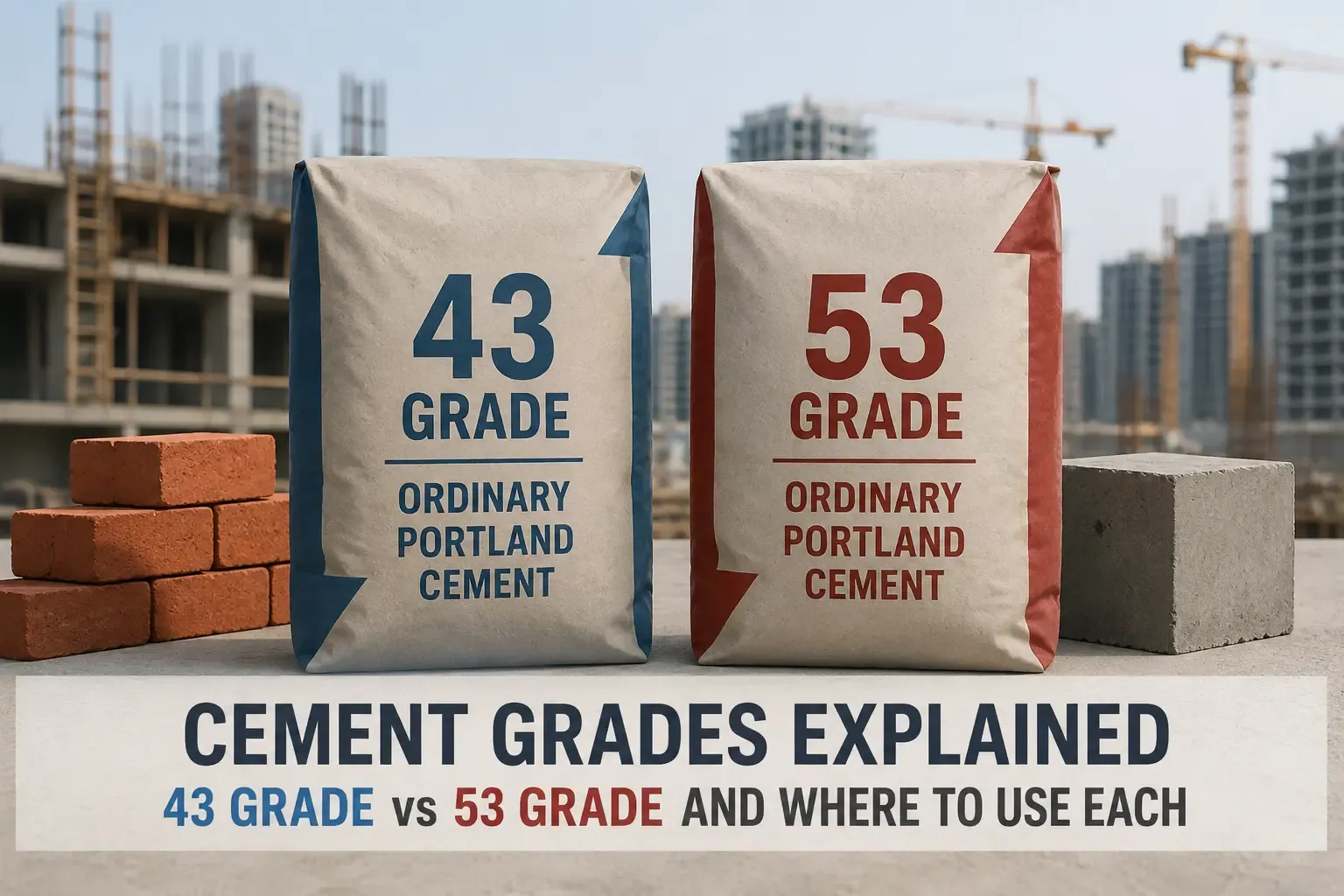
You’re standing at the dealers counter ready to buy cement for your house, the dealer asks one question: “43 grade or 53 grade?”
Most people catch themselves for a second, then they’ll pick based on price, or what the mason used last time, or just make an assumption – “53 is a bigger number, so it must be better” – totally without knowing what those numbers actually mean.
But there’s a problem with just winging it: sometimes 53 grade is spot on for the job & sometimes it’s a complete waste of money. Conversely sometimes 43 grade is the sensible choice, but sometimes it leaves your structure weaker than it should be. The 43 grade vs 53 grade cement decision isnt about which is “better”. Its about which is right for the job in front of you.
This guide should finally clear it all up – what on earth does that grade number actually mean, what are the real facts behind each one, and exactly when to use which.
What Does Grade Actually Mean?
The grade of cement isn’t some flashy marketing gimmick, rather a straightforward measure of the stuffs strength.
To figure out just how strong a cement is, a standard mortar cube gets mixed up (cement mixed with sand and water in a pretty standard ratio) and left to set for a month. Then, after that 28 day waiting period, the cube gets whacked in a machine until it breaks – and that’s when we find out how much pressure it takes to shatter the thing. That number – and its in newtons per square millimetre (N/mm², also written as MPa) – is the grade.
So the number itself is basically telling you what the minimum 28-day compressive strength of the cement is:
- 43 grade means that at 28 days that cement is good for at least 43 N/mm² of compressive strength.
- 53 grade means its at least 53 N/mm² at 28 days.
Both are Ordinary Portland Cement (OPC). In India its the case that 43 grade is specified in IS 8112 and 53 grade in IS 12269 – and these are the Bureau of Indian Standards guidelines that set the minimum standards that each grade has to clear. (The 33 grade has largely vanished from the market now, older things often being what they are.)
Thats the basic idea – the higher the number the higher the tested strength. But strength is only one part of the whole story, and thats where a lot of people will start reading a bit too quickly and make a few errors.
The Data: 43 Grade vs 53 Grade Side by Side
Strength doesn’t only matter at 28 days. What happens in the first few days decides how fast you can strike formwork, how the concrete behaves, and how much curing attention it needs. Here are the minimum strength figures each grade must meet under Indian standards:
| Strength benchmark | 43 Grade (IS 8112) | 53 Grade (IS 12269) |
|---|---|---|
| 3-day compressive strength | 23 N/mm² (min) | 27 N/mm² (min) |
| 7-day compressive strength | 33 N/mm² (min) | 37 N/mm² (min) |
| 28-day compressive strength | 43 N/mm² (min) | 53 N/mm² (min) |
The Key Differences That Actually Matter
Strength numbers are just the starting point. Here’s what sets these two grades apart on the ground
Early Strength & Setting Speed – The 53 grade stuff gains its strength in a hurry. That’s super useful on big projects where you don’t want to be waiting around for formwork to come off and the next stage to start. You need to get in there & move on quickly. 43 grade takes longer to gain its strength.
Heat of Hydration – This is the thing nobody normally talks about, but it’s a big one. When you mix cement & water, it gives off heat. The 53 grade is ground finer and so it reacts way faster – so it generates more heat quicker. And this means you get a higher risk of shrinkage & thermal cracks if you don’t get the concrete properly & promptly cured. 43 grade on the other hand takes its time releasing heat, which makes it less of a drama to work with.
Curing Demands – 53 grade not only benefits from good curing – it actually needs it. If you pour 53 grade and then forget to keep it hydrated you can turn that fast early strength into surface cracks. 43 grade is a lot easier to deal with when curing conditions aren’t perfect.
Cost – 53 grade usually costs a few dollars more per bag compared to 43 grade. On a small home you might not even notice the difference, but on a big structure using hundreds of bags it can add up – which is exactly why using the higher grade when you dont really need to is just throwing money away.
So the honest low down is this: 53 grade is stronger and faster but also hotter & a lot less forgiving. 43 grade is a bit slower and lower at peak strength but steady as a rock & easier to work with.
Where to Use 43 Grade Cement
43 grade cement is the reliable all-rounder for general and residential construction projects. Grab it when:
- You’re building a low-rise home – a simple 2-3 story building that doesn’t need to carry too much weight.
- You’re doing standard reinforced concrete work – the kind of beams, columns and slabs you’d see in the average residential building.
- You need a cement that’s good for plastering jobs, brickwork and flooring – nothing too fancy where a super strong mix isnt really necessary.
- You’re working with structures that dont need a whole lot of support – 43 N/mm² is plenty strong enough.
- Your site conditions are pretty basic, and you want to be able to get away with a more forgiving cement that wont crack under heat stress.
For most small-time home builders in Assam, Meghalaya, Tripura and across the whole of the Northeast, 43 grade is all they need to get their average house up and running comfortably
Where to Use 53 Grade Cement
A 53 grade cement earns its keep when you really need higher strength than that. You can use it for:
- High rise buildings and multi storey buildings where the columns and beams are under huge loads all the time.
- Things like pillars and beams that need to be able to take a massive amount of weight, and also any other load-bearing structural parts that really need to be strong.
- High strength concrete jobs especially when you’re working with reinforced concrete that needs to be at least M25 grade or better.
- Bridges, pre cast bits and pieces of concrete, and any type of prestressed concrete job, where both how strong it is straight away, and how strong it’ll be in the long run is vital.
- Foundations under heavy loads and big industrial or commercial projects
But – and this is a big one – all of this is only true if you get the curing just right. Get a higher grade and then just skip the curing altogether, and you’ll have just wasted your money on a product that’s already starting to show cracks
The Myth That Trips Everyone Up: Cement Grade Is Not Concrete Grade
This single misunderstanding causes more confusion than anything else, so it’s worth being clear.
The grade of cement (43 or 53) is not the same as the grade of concrete (M15, M20, M25, and so on). Concrete grade is decided by the mix design — the proportions of cement, sand, aggregate, and water — not by the cement grade alone.
With the right mix design, 43 grade cement can be used to produce strong, structurally sound concrete for ordinary buildings. You don’t automatically need 53 grade to get a good result. What you need is the correct grade for the load, plus a proper mix and disciplined curing. That combination matters far more than always chasing the bigger number on the bag.
A Realistic Look at the Numbers
Imagine a homeowner in Guwahati building a typical two-storey house & their aunt tells them “alot of people use 53 grade because its stronger, you should do the same”, so they decide to use 53 grade for the whole build – from the foundation to the roof – columns, slabs, plaster – all of it.
For the plasterwork and the lower load bearing internal parts, that 53 grade means the plaster sets a lot faster than it needs to which brings with it more than the job can handle. When a hot & dry spell hits, several of the plastered walls develop hairline cracks because the high reaction cement hadn’t been cured as diligently as 53 grade would demand – and all of this while also footing the higher price per bag for the whole house, including all the areas where 43 grade – which has a much steadier temperament and less heat – would have done the job without any issues.
Now imagine that same homeowner using 53 grade for the structural columns and the load bearing parts that actually reallly need the extra strength, and 43 grade for the whole rest of the house – slabs, plaster, and general masonry. The structure gets the strength it needs, the plaster behaves, & the cement bill comes down a lot – all just because they chose the right grade of cement for the job, not just the one thats the biggest number.
Thats the whole lesson in 1 build: using the right type of cement always beats opting for the higher one every single time.
Conclusion
43 Grade vs 53 Grade Cement – the answer may seem obvious but its not always “go for the more expensive 53 grade”. First off, ‘grade’ is actually a measure of strength and not quality. In reality, 43 grade is generally a safe bet for most residential and general building projects where you just need a dependable foundation.
But if you’re building something that needs to hold a lot of weight, or support heavy loads – and you’re prepared to do the job right – then 53 grade might be the way to go. The catch is you need to commit to proper curing if you want to get the most out of it.
Match the job up with the right grade, get a good mix design sorted & make sure you’re curing it right & your structure will get the strength it was designed for, no more no less
At Amrit Cement, we’re all about making cement that actually performs the way it should from roof to foundations – and we’d rather help you pick the right product for the job, rather than trying to sell you the fanciest one. To find your nearest dealer or learn which grade fits your build, visit amritcement.com.
FAQ
Which one’s the way to go, 43 grade or 53 grade cement?
To be honest, it’s not like one is better than the other – they’re just suited to doing different jobs. 43 grade is pretty much the safe bet for everyday residential construction, whereas 53 grade is what you want for those high-strength jobs that need to support really heavy loads. You pick the right one for the job it’s got to do, not just because one’s got a higher number.
Can I get away with using 43 grade for a slab or a roof?
Yeah, for your average residential slabs and roofs 43 grade is fine, as long as you get the mix right and give it the right cure. But if you’re building a high-rise or a slab that’s carrying a load – you know, a lot of weight – then 53 grade is the safer option.
How well does 53 grade cement do for house construction?
It’s a great choice for the load-bearing parts of a house – columns, beams, and the like. But don’t expect it to be a dawdler, ‘cos it sets fast and gives off some heat. Best keep an eye on it. For plaster and general work though, 43 grade is probably the better bet – it’s easier to work with and more forgiving.
What’s the main difference between 43 and 53 grade cement then?
Well the number – 43 N/mm² versus 53 N/mm² – that’s the minimum 28-day compressive strength. But if you look closer, 53 grade gets its strength up faster and cranks out more heat, whereas 43 grade is nice and steady, cooler, and easier to get on with.