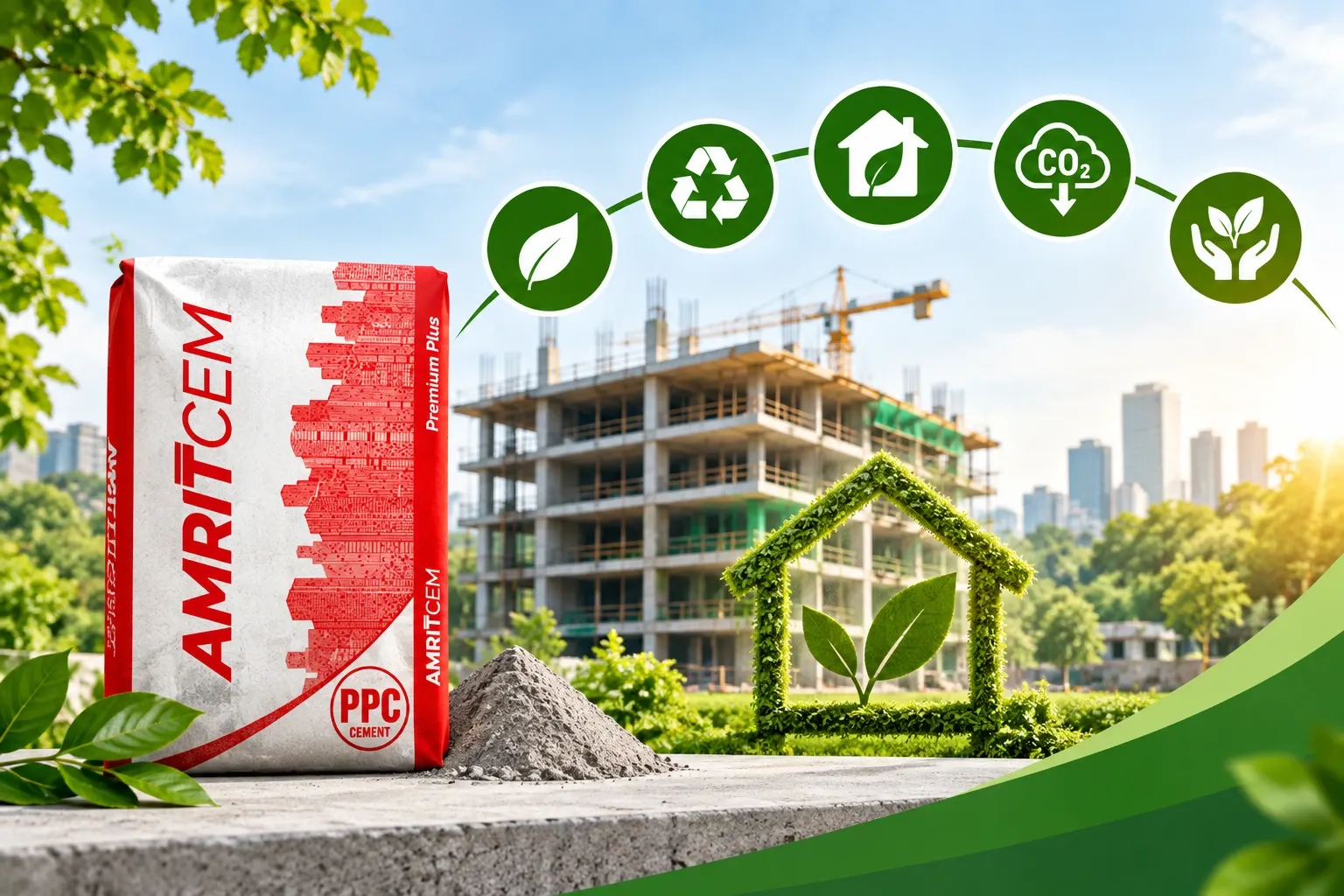
Many of its environmental decisions are made much earlier. How much material will the structure consume? Where will those materials come from? Can industrial by-products be put back to use? And will the finished building last long enough to avoid unnecessary repair and replacement?
Cement belongs in this discussion because it is used in such large quantities.
This is also where Portland Pozzolana Cement PPC has an interesting role. By using fly ash as a pozzolanic material, PPC reduces dependence on clinker while making productive use of an industrial by-product.
For sustainable construction in Northeast India, where durability must also stand up to heavy rainfall and prolonged moisture exposure, that combination deserves attention.
Start With the Material We Are Not Producing
Most conversations about green materials focus on what has been added.
With PPC, it is equally useful to look at what has been reduced: clinker.
Clinker is an essential component of conventional Portland cement, but producing it requires limestone and other raw materials to be heated at very high temperatures. This consumes energy. The chemical conversion of limestone during the process also releases carbon dioxide.
PPC changes the composition.
A portion of clinker is replaced with pozzolanic material such as fly ash. Under Indian Standards, fly-ash-based PPC can contain 15% to 35% fly ash by mass.
This does not make cement carbon-free. It does, however, reduce the quantity of clinker required for the finished cement.
And in cement manufacturing, that is an important difference.
Then There Is the Fly Ash
Fly ash already exists as a by-product of coal-based thermal power generation.
Suitable fly ash can be processed and used in PPC rather than depending entirely on clinker for the cementitious composition.
This is one of the most practical fly ash cement benefits.
An industrial by-product becomes a useful construction input.
But fly ash is not included merely to fill space inside the cement.
It reacts.
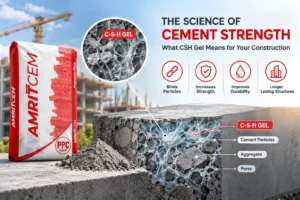
During cement hydration, calcium hydroxide forms as one of the reaction products. The reactive components of fly ash can react with it and contribute to additional cementitious compounds over time.
This can help concrete develop a denser internal structure when it is properly designed, mixed, compacted and cured.
So, the value of fly ash in PPC works on two levels: it reduces clinker requirement and contributes to the long-term performance of the cementitious system.
Green Construction Also Has to Survive the Weather
This becomes particularly relevant in Northeast India.
The region experiences long periods of rain, high humidity and regular moisture exposure. Buildings have to deal with wet ground, driving rain, roof water and damp conditions for a significant part of the year.
A material cannot be called useful for green construction simply because its manufacturing footprint is lower. It also needs to suit the conditions in which the building will stand.
PPC is known for good long-term durability and can support lower permeability in properly made concrete. It also generally produces less heat during hydration than OPC.
These characteristics make Portland Pozzolana Cement PPC useful across many construction applications, subject to the project’s design and engineering requirements.
For sustainable construction in Northeast India, durability is not separate from sustainability.
A structure that performs well for longer can reduce premature repair, replacement and the additional material consumption that comes with them.
But PPC Cannot Do the Whole Job
This is where green-building conversations sometimes become too product-focused.
Choose PPC. Choose efficient lighting. Install solar panels. Add rainwater harvesting.
Useful decisions, certainly.
But construction quality still sits underneath all of them.
Take PPC concrete and add unnecessary water to make placement easier. Its final quality can suffer.
Stop curing too early and you may not get the performance you expected.
Ignore drainage and water will keep finding vulnerable parts of the structure.
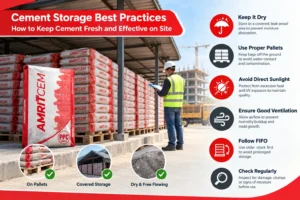
Order too much cement and allow it to absorb moisture in storage, and a supposedly sustainable material simply becomes waste.
The material matters. What the site does with it matters just as much.
What PPC Actually Contributes to a Greener Building
Instead of giving PPC a broad “green” label, its contribution can be understood through a few very specific changes.
| What PPC Does | Why It Matters |
|---|---|
| Replaces part of clinker with fly ash | Reduces clinker requirement |
| Uses an industrial by-product | Makes productive use of an existing material |
| Generally produces lower heat of hydration than OPC | Useful where heat development needs attention |
| Supports good long-term durability | Can contribute to longer-lasting concrete |
| Can help develop a denser concrete structure | Supports durability when concrete is made correctly |
These are practical fly ash cement benefits.
None of them removes the need for correct structural design, mix proportioning, compaction, curing or waterproofing.
Sustainability Is Also Becoming a Business Question
There is another change happening around construction materials.
Developers, infrastructure companies, investors and manufacturers are paying greater attention to environmental, social and governance performance—usually shortened to ESG.
For cement companies, the environmental part is particularly significant because manufacturing is energy- and carbon-intensive.
An ESG cement company therefore has to look beyond simply selling cement. Questions around clinker reduction, energy efficiency, alternative materials, waste utilisation, emissions, resource use and long-term environmental performance increasingly become part of the conversation.
PPC fits naturally into this transition because reducing clinker content is one established route for lowering the carbon intensity of cement.
But ESG should not become another label either.
What matters is measurable action: how materials are sourced, how efficiently plants operate, how industrial by-products are used and how manufacturers work towards reducing environmental impact.
Where AmritCem PPC Fits Into the Picture
For Amrit Cement, PPC brings this sustainability discussion into a product used in everyday construction.
AmritCem PPC uses fly ash along with clinker and gypsum. By replacing a portion of clinker with fly ash, the cement reduces its dependence on the more carbon-intensive clinker component while putting an industrial by-product to useful work.
Its relevance is also practical for Amrit Cement’s core Northeast market.
AmritCem PPC can be used across applications such as foundation-to-roof construction, masonry, plastering and mass concrete, depending on project requirements.
That means a lower-clinker cement does not have to remain limited to a special “green project.”
It can become part of normal material selection.
For an ESG cement company, that is where sustainable products can make a broader difference: not only in flagship projects, but in the large volume of ordinary construction happening every day.
A Greener Building Is Usually the Result of Many Ordinary Decisions
The cement is one.
So is the quantity ordered.
So is the distance materials travel.
So is proper storage.
Water use matters. Construction waste matters. Design matters. Energy consumption after people move into the building matters too.
This is why no single sustainable building material should carry the entire green-building claim.
PPC makes a specific contribution.
It allows part of the clinker to be replaced by fly ash. That can reduce the carbon impact associated with clinker production while putting an industrial by-product back into productive use. Its long-term performance characteristics can also support durable construction when the material is used correctly.
For sustainable construction in Northeast India, that is a useful combination.
Not because PPC suddenly makes concrete “green.”
But because better construction often starts exactly this way: improving one material choice, then making sure the rest of the building does not waste the advantage.
FAQs
1. What makes Portland Pozzolana Cement PPC a greener building material?
Portland Pozzolana Cement PPC replaces part of the clinker with pozzolanic material such as fly ash. This reduces clinker requirements and makes productive use of an industrial by-product.
2. What are the main fly ash cement benefits?
Important fly ash cement benefits include reduced clinker dependence, productive use of fly ash, lower heat of hydration and good long-term durability when the concrete is properly designed and constructed.
3. Why can PPC be useful for sustainable construction in Northeast India?
PPC combines a lower-clinker composition with characteristics that can support long-term concrete durability. This can be relevant in Northeast India’s wet and humid conditions, although drainage, waterproofing, curing and workmanship remain essential.
4. Does PPC make a building completely eco-friendly?
No. Cement is only one part of a building. Sustainable construction also depends on efficient design, responsible material use, reduced waste, water and energy management, construction quality and long-term durability.
5. How does PPC relate to an ESG cement company?
Reducing clinker dependence and using suitable industrial by-products are among the measures that can contribute to lowering the environmental impact of cement. For an ESG cement company, these material and manufacturing decisions form part of a much wider sustainability strategy.