The ground-floor roof has been cast. The contractor wants to start the next floor. The homeowner wants the work finished before the rains arrive. Everyone has the same question: how many days should we wait?
It sounds like a question that needs one number. It does not. Concrete curing time before next floor construction is only one part of the decision. Concrete must develop enough strength for the loads coming onto it. The supporting formwork and props must also be managed correctly. Starting too early can place loads on a slab that is not yet ready to carry them.
The sensible answer comes from the engineer’s construction plan, not a date marked on the calendar.
Curing time and loading time are not the same thing
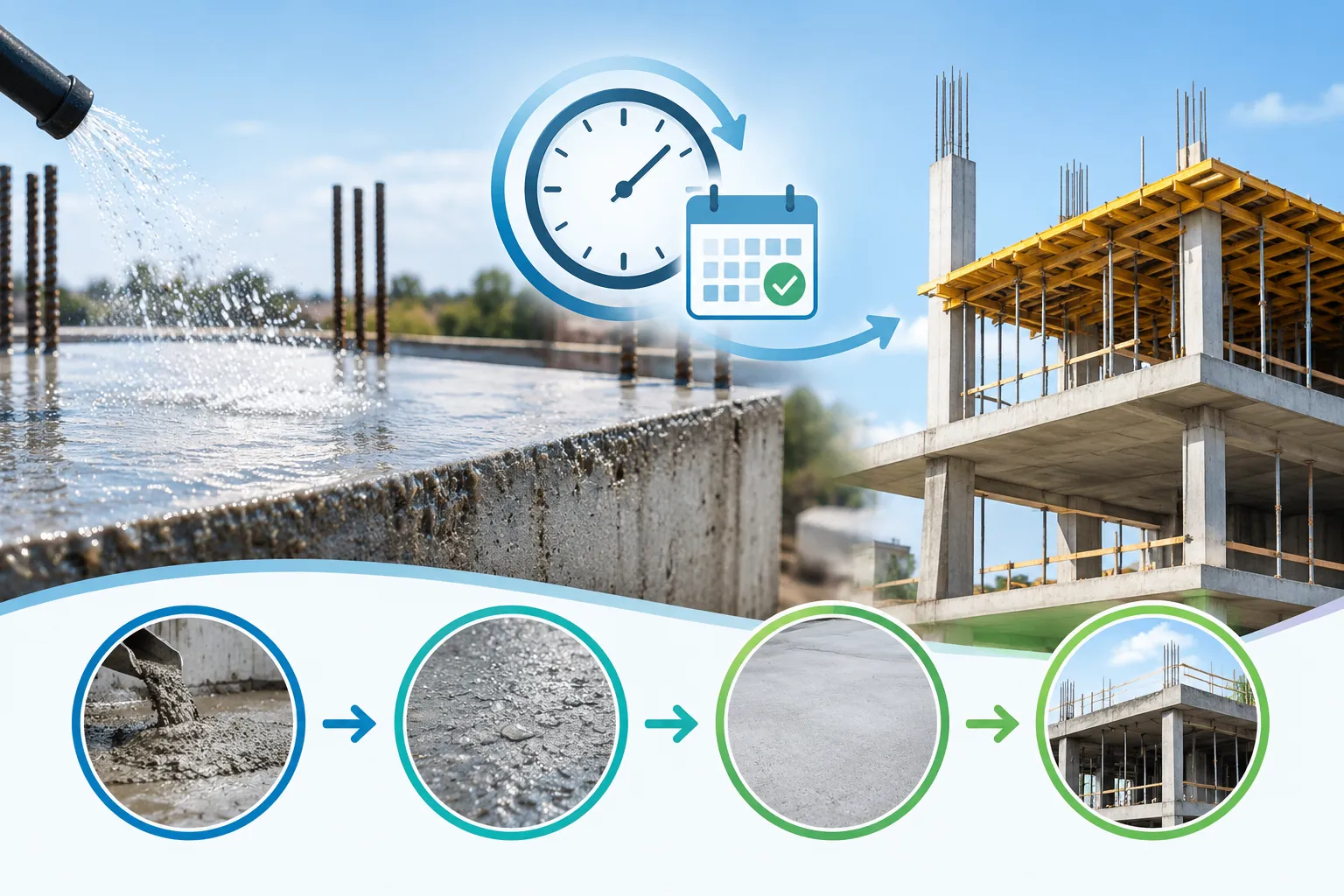
Curing means keeping newly placed concrete under suitable moisture and temperature conditions so cement can continue to react with water. This reaction helps concrete gain strength and become more durable. Loading means placing weight on the slab: workers, bricks, cement bags, scaffolding, formwork and the materials needed for another floor.
A slab can look dry and hard on top while strength is still developing inside it. A well-cured surface is not proof that the full slab can safely support new construction loads. That is why a simple rule such as ‘start the next floor after seven days’ can be misleading.
Ask two separate questions. Has the concrete received the required curing? Has the engineer confirmed that the slab and its temporary supports can safely take the next stage of work?
What happens during the first few weeks?
When cement and water are mixed, hydration begins. Concrete gradually hardens and gains strength. The pace depends on cement type, mix proportions, temperature, curing conditions and other materials in the concrete.
Early strength can develop quickly under suitable conditions, but development continues beyond the first week. Concrete strength is commonly assessed at specified test ages, often including 7 and 28 days. The 28-day result is a common reference for specified compressive strength; it is not a universal date on which every slab automatically becomes safe for any loading.
Portland Pozzolana Cement (PPC) may develop early strength differently from Ordinary Portland Cement (OPC), while offering useful long-term characteristics. Neither cement type removes the need for proper curing or an engineer-approved loading sequence.
What actually decides when the next floor can begin?
The first factor is the structural design. Slab thickness, span, reinforcement, beam arrangement and concrete grade influence how the slab carries loads. The second is actual strength development. Site conditions do not always match ideal laboratory conditions.
The third factor is how the next floor will be built. A few workers walking over the area create a different demand from stacks of bricks, reinforcing steel, formwork and fresh concrete for another slab.
Finally, there is temporary support. Props and reshoring may transfer construction loads through more than one level. Removing them or moving them without a plan can change how loads travel through the structure. Formwork removal and permission to build above are therefore related, but they are not interchangeable decisions.
Why ‘the slab looks strong’ is a poor test
A hard surface tells you that the concrete has set. It does not tell you the in-place compressive strength, the capacity of a beam or whether the planned construction loads are safe.
Likewise, a contractor’s experience with the previous house cannot replace the specifications for this one. A shorter span, a different slab design or a different mix can change the answer.
Do not use tapping, scratching or visual appearance as the basis for structural loading. If there is doubt, the engineer can review the records, assess the curing history and decide whether additional testing or support is needed.
How to check strength without guessing
Concrete cube tests can provide information about the strength of sampled concrete at selected ages. However, standard-cured cubes do not always represent the exact strength of a slab exposed to sun, wind or poor curing on site.
For decisions linked to early formwork removal or loading, the engineer may need evidence that reflects in-place strength. Field-cured specimens, suitable maturity methods or other approved assessment procedures may be considered, depending on the project. No single test number should be read without understanding the sampling, curing and test method.
Keep a simple record: casting date, concrete grade, cement used, mix design, curing method, interruptions and test results. These details are far more useful than a photograph of the finished slab.
A practical sequence for homeowners
Immediately after casting: protect fresh concrete from damage, heavy rainfall and rapid moisture loss. Start curing at the appropriate time for the chosen method.
During curing: maintain the specified curing conditions. Do not leave the slab to dry because someone wants to start another job. Check that water curing or the approved alternative is actually being carried out.
Before removing props: ask for the engineer’s instructions and the applicable formwork and reshoring plan. Do not allow workers to remove support because it is needed somewhere else.
Before storing materials upstairs: agree on permitted loads and storage locations. A tightly packed stack of bricks can place a high load over a small area.
Before next-floor work: obtain confirmation that the structure and supports can safely handle the proposed construction activity. The answer may differ for light preparation work and for casting another level.
Monsoon conditions need extra attention
In Assam and Meghalaya, long periods of rain may make curing seem easier. Rain does not replace an organised curing plan. Strong rainfall can damage very fresh concrete, while breaks in the rain can leave surfaces drying out.
Wet sand also changes the water already present in the concrete mix. If extra water is added without checking aggregate moisture, the concrete may not perform as intended. Protect cement bags from damp storage and keep records of the actual mix used.
On sloping sites, access, material storage and formwork stability deserve attention before heavy materials are lifted to an upper floor.
Where Amrit Cement fits into the decision
Amrit Cement supplies OPC and PPC for different construction applications. The product choice should match the structural specification rather than a promise of a faster building schedule. AmritCem PPC can be considered where PPC is specified and its long-term properties suit the work.
Through Amrit Support, the company lists concrete cube testing, slump testing, mix-design support and site-related technical guidance among its services. These can help homeowners ask better questions about concrete quality. The engineer still decides when props can be removed and when new structural loads are permitted.
Good cement and useful testing support the process. Neither can make a young slab carry more load than its design and present strength allow.
Before the contractor starts upstairs
- Confirm the engineer-approved construction and loading sequence.
- Check that curing has continued for the specified duration.
- Review concrete strength records and any needed in-place assessment.
- Confirm which props or reshores must stay in position.
- Avoid heavy material stacks without an approved loading plan.
- Check that weather, access and safety arrangements are ready.
The next floor should begin when the structure is ready, not simply when the team has finished other work.
FAQs
Is seven days enough before building the next floor?
Not as a universal rule. The engineer must consider strength development, planned loads and temporary supports. Curing duration alone cannot decide when the next floor is safe.
Does concrete gain all its strength in 28 days?
No. Twenty-eight days is a common specified testing age. Concrete can continue gaining strength after that, depending on its materials and curing conditions.
Can I remove slab props once the surface is hard?
No. Surface hardness is not proof of safe load capacity. Follow the engineer-approved formwork removal and reshoring plan.
Does PPC need attention to curing?
Yes. AmritCem PPC, like other cement products, needs suitable mixing, placement and curing to achieve the intended concrete performance.
Can Amrit Support approve the next floor?
Amrit Support lists concrete testing and technical guidance services, but permission to load the slab or continue structural construction must come from the responsible engineer.