The development of infrastructure in India is highly related to the success of the cement industry. Almost all building projects in the country be it housing, road construction projects, commercials buildings or industrial plants use cement as base material. The Indian cement industry has over the past few decades experienced a high growth rate in production, technology and market coverage.
India is now one of the largest producers of cement in the world today. This has been boosted by increasing housing demand, government infrastructure development and urban development. Many builders, contractors, and home owners often search for India top cement brands before starting construction, as the quality of cement directly affects the strength and life of a structure.
This paper describes the rise of the Indian cement industry, the capacity of this industry, and the contribution of the large cement producers.
The Indian Cement Industry is Growing
The cement sector in India began to develop at the beginning of the 20th century, although the rapid growth came after the nation started paying much attention to building infrastructures and houses.
In the past two decades, construction demand has grown in cities, towns, and the rural setting. The increasing demand of cement has also been occasioned by government programmes involving affordable housing, development of highway, industrial corridors and smart cities.
The industry has grown under the support of a number of factors:
1. Increasing Housing Demand
The population and urbanization of India has generated a continuous demand of residential buildings. The construction of individual houses and apartment buildings in the country take a huge portion of the cement manufactured in the country.
2. Infrastructure Development
Cement is required in the huge amounts in road networks, metro rail work, bridges, airports and ports. The more the infrastructure money is spent, the more cement is produced.
3. Expansion into New Regions
The cement manufacturing plants of many cement companies have been developed nearer to the raw materials which include limestone deposits. This assists in the increase of supply efficiency and lowers the costs of transportation.
Due to such developments, the Indian cement industry has emerged as one of the most competitive manufacturing industries in the country.
The Cement Production Capacity in India
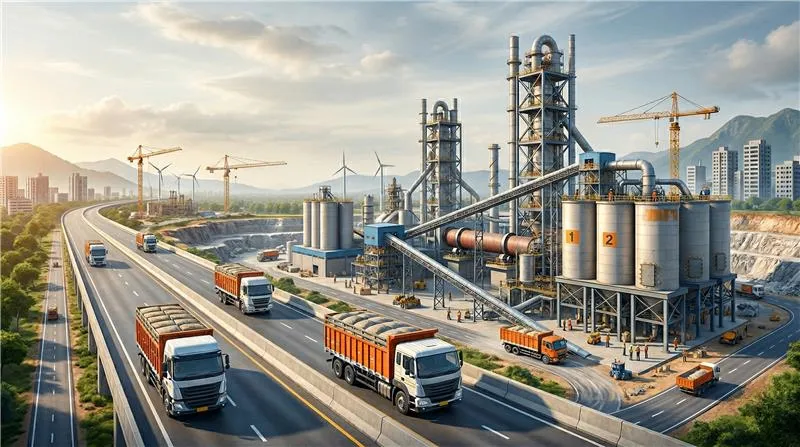
India has developed a huge cement production foundation to assist its construction requirements. The cement plants are situated in various states where the limestone is located.
There are now hundreds of cement manufacturing plants in operation in the country which operate by mega national companies as well as local manufacturers. All these plants create a huge production capacity that is utilized in both domestic construction and export markets.
The industry has generally been categorized in two classes of production units:
Massive Integrated Cement Plants
These plants produce cement at the start of the process. They mix limestone and other raw materials to form clinker which is further refined to cement.
Grinding Units
Clinker processed into finished cement in grinding units is received by integrated plants. Such units tend to be near construction markets.
This production system helps cement firms to have constant supply in various regions of India.
The number of manufacturers of cement also keeps on increasing their production capacity through construction of new facilities or renovation of the current plants. These expansions are beneficial in responding to the increased demand of infrastructure and housing projects.
Distribution of Cement Plants in the Region
The cement plants in India are normally established in areas where limestone is found. The most significant raw material in the cement manufacturing is limestone.
The large cement-producing areas are:
Southern India
- Andhra Pradesh
- Telangana
- Tamil Nadu
These states contain large deposits of limestone and are home to numerous large cement plants.
Eastern India
- Odisha
- West Bengal
These states have recorded an increment in cement production due to increased construction activity.
Northern India
- Rajasthan
Rajasthan is one of the largest cement producing states as it is the land of limestone.
Central India
Some of the cement manufacturing units are also located in:
- Madhya Pradesh
- Chhattisgarh
This localized distribution enables the cement firms to serve the local markets effectively and have stable distribution channels.
Large Indian Cement Market Competitors
The cement sector in India is a big business comprising of a few regional firms and major companies in India. Each cement company name in the market contributes to the industry through production capacity, distribution networks, and product quality.
There are those companies which run several cement plants in various states whereas some involve regional markets where they have distribution systems that are good.
- Large cement producers usually distribute cement to several states and serve huge construction works.
- Regional companies usually establish good relationships with local dealers, builders and contractors.
When people search for India top cement brands, they usually consider factors such as:
- Product quality
- Availability
- Brand trust
- Consistency in supply
It is also a common trend in many companies to place emphasis on the enhancement of cement performance through the use of better manufacturing technology, quality testing systems and efficient logistics.
Technology in Cement Production
Cement manufacture process has undergone tremendous changes due to development of technology. Contemporary cement plants have superior machinery and automated benefits that guarantee the quality of the products.
Technology assists the manufacturers in the following ways:
- Enhancing efficiency in production
- Energy conservation
- Minimal variability of cement composition
- Assurance of quality testing within various products
The Significance of Selecting the Appropriate Cement Brand
The choice of the appropriate cement brand is a significant issue to builders and home owners. Cement quality influences the structuring, endurance, and safety of a building.
When evaluating India top cement brands, people usually look for factors such as:
- Consistent product quality
- Consistent distribution within their market
- Good reputation among construction firms
- Strong dealer network
The existing businesses are more concerned about standards of quality since any slight change in the cement composition can influence the construction work.
Final Thoughts
The Indian cement sector has been increasing in tandem with the development of the Indian infrastructure and housing. The industry has maintained high volume constructions in the country with the expansion of its production capacity, better manufacturing technology, and the use of powerful distribution systems.
From large national manufacturers to regional producers, every cement company name plays a role in meeting the growing demand for cement.
For builders and home owners, understanding how the industry works makes it easier to identify reliable India top cement brands that support durable and safe construction.
With the Indian government still developing new cities, roads, and infrastructures, the cement industry will still be a major sector that is supporting the development of the country.
FAQs
FAQ 1: Why is the Indian cement industry growing rapidly?
India’s cement demand is growing due to infrastructure development, urban housing projects, highways, and industrial expansion. Government initiatives and rising construction activity have increased cement consumption across the country. Companies like Amrit Cement are contributing to this growth by supplying quality cement that supports both residential and commercial construction projects.
FAQ 2: How does the cement industry impact construction businesses?
The cement industry plays a key role in construction supply chains. Reliable cement supply ensures projects run smoothly without delays. When manufacturers maintain quality and distribution networks, contractors and builders can plan projects confidently. Amrit Cement focuses on consistent production and efficient distribution to support growing construction demand.
FAQ 3: Why is cement production capacity important for the industry?
Production capacity determines how much cement a company can supply to the market. Higher capacity helps meet increasing construction demand and prevents shortages. Companies like Amrit Cement continuously improve production systems to maintain steady supply and support large-scale construction activity.
FAQ 4: How do cement companies compete in the Indian market?
Competition in the cement industry depends on product quality, pricing, distribution network, and brand trust. Companies that maintain consistent strength and reliable supply gain preference among contractors and builders. Amrit Cement focuses on quality manufacturing and strong dealer networks to remain competitive in growing markets.
FAQ 5: What should contractors and home owners consider when choosing a cement brand?
They should look for consistent quality, brand reputation, dealer availability, and product suitability for their project. Reliable brands like Amrit Cement ensure uniform strength, dependable supply, and strong performance in construction, helping builders avoid risks and maintain structural quality.