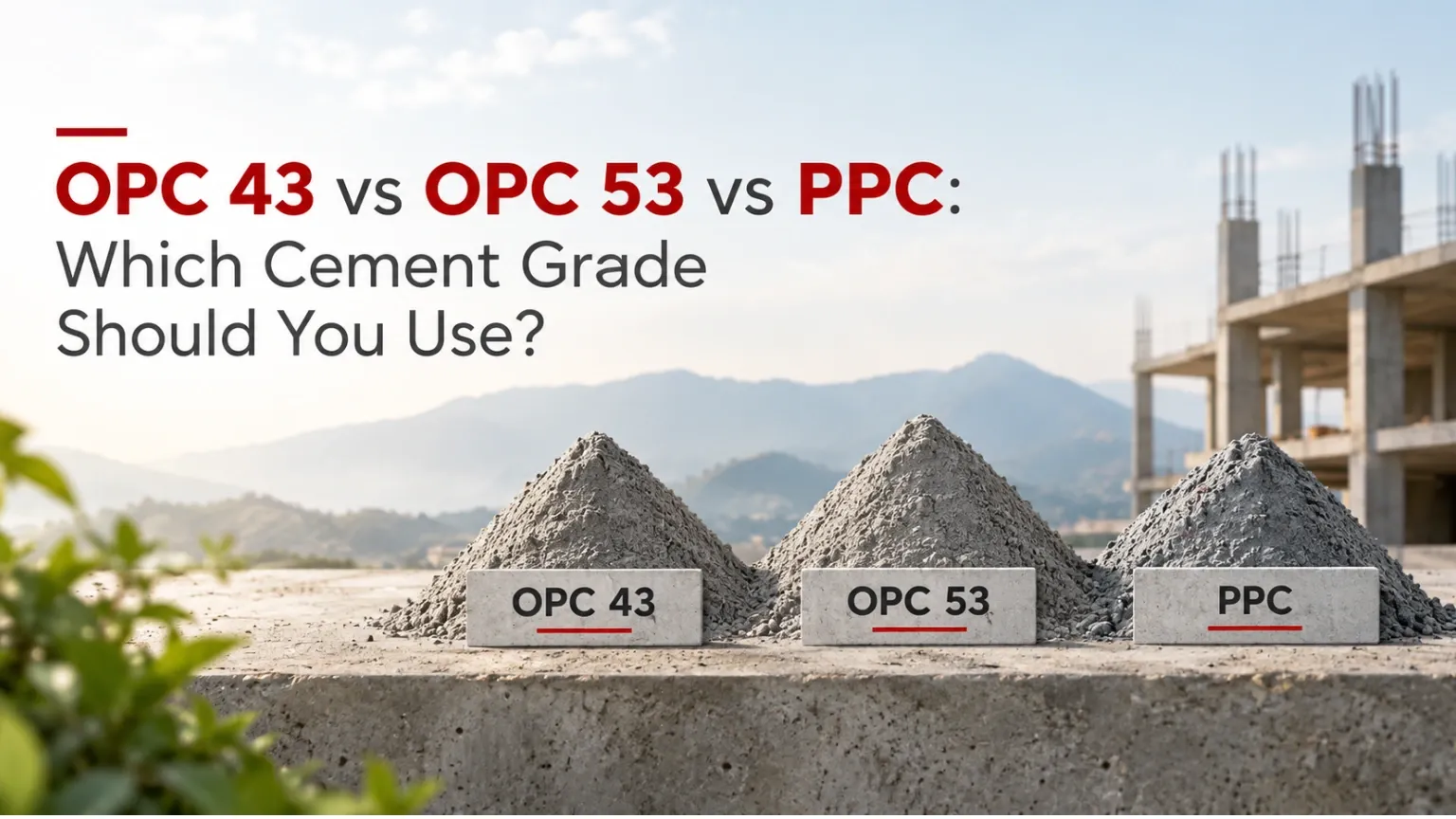
OPC 43 vs OPC 53 vs PPC: Which Cement Grade Should You Use?
You’re strolling into a cement shop and you hear the same three names: OPC 43, OPC 53 and PPC. Your local mason might swear by one, an engineer might recommend another, and the salesperson might try to flog you with a third.
So what’s the best choice for your house? To be honest, it really comes down to the specifics of your project. Each type has its own unique benefits. This guide breaks down the difference between OPC and PPC cement in a way that even a non-expert can understand, and gives you a better idea of which one to use when.
What’s OPC Cement All About?
Ordinary Portland Cement (OPC), is made from grinding up clinker (which is essentially ground down limestone and clay) with a bit of gypsum chucked in for good measure. It’s the good old traditional kind of cement.
OPC comes in three grades: OPC 33, 43 and 53 – the number tells you the minimum compressive strength that a standard test sample would reach after 28 days. So OPC 53 has got to reach at least 53 megapascals (MPa), while OPC 43 gets there at 43 MPa. All three of these grades are covered by the standards laid out in IS 269:2015.
Incidentally OPC 33 is pretty much not used any more, so for most home builders it’s down to deciding between OPC 43 and OPC 53.
What’s PPC Cement?
Portland Pozzolana Cement (PPC) is a bit of a different story – this stuff is made by blending OPC clinker with some pozzolanic material – usually fly ash, along with some gypsum. It all gets covered under IS 1489 (Part 1):2015.
Fly ash starts off by slow-burning away, reacting with the by-products of cement formation and over time forming some extra binding compounds which in turn makes PPC get stronger & stronger over the months and even denser & more durable in the long run
OPC 43 vs OPC 53 vs PPC: Side-by-Side Comparison
| Feature | OPC 43 | OPC 53 | PPC |
|---|---|---|---|
| Composition | Clinker + gypsum | Clinker + gypsum (finer, higher strength) | Clinker + fly ash + gypsum |
| Early strength | Good | Very high | Lower at first |
| Long-term strength | Good | High | Keeps improving over time |
| Heat of hydration | Moderate | High | Low |
| Risk of shrinkage cracks | Moderate | Higher if not cured well | Lower |
| Durability & water resistance | Good | Good | Very good: denser, less permeable |
| Resistance to sulphates & chemicals | Moderate | Moderate | Better |
| Workability & finish | Good | Good | Smooth, very workable |
| Curing | Needs proper curing | Needs careful curing | Needs longer, consistent curing |
| Eco-friendliness | Standard | Standard | Better: uses fly ash, lower carbon footprint |
| Best for | General RCC, residential | High-strength, fast-track RCC | Most house construction, plaster, masonry, foundations |
Understanding the Key Differences
Strength: Early vs Long Term
OPC 53 gets a fast strength boost which makes it a popular choice for sites where formwork has to come down in a hurry or loads start arriving early. In contrast, PPC takes a bit longer to get going but keeps chugging along long after 28 days is past. For your average home, where structures get a proper finish and loads are added gradually, PPC’s long term strength is way more than enough.
Heat and Cracking Issues
When cement meets water, it starts putting out a lot of heat and that can lead to some pretty nasty cracks – thermal and shrinkage cracks – especially in plaster and big pours if the curing process isn’t done just right. Not so with PPC, which generates far less heat and is a lot gentler on the structure, less prone to cracking.
Durability in Wet Weather
PPC makes a more dense concrete with fewer little gaps in it. That means less water sneaks in and rusts the steel reinforcement. It really shines in the Northeast with all its heavy rain and high humidity – PPC’s a real winner there.
Price Tag
Typically, OPC 53 is the priciest of the bunch, followed by OPC 43, with PPC being the most budget friendly option. The price gap between the three has been narrowing, though – PPC’s discount to OPC 53 is now around 5-8%, down from 10-12% just a few years ago.
Which Cement Should You Use? A Job-by-Job Guide
| Construction work | Recommended cement | Why |
|---|---|---|
| Foundation & footings | PPC | Durable, resists moisture and soil chemicals |
| Columns & beams | OPC 43 / OPC 53 or PPC (as per engineer) | Needs reliable structural strength |
| Roof slab (Dhalai) | OPC 43 / PPC (as per engineer) | Balance of strength and crack resistance |
| High-strength or fast-track RCC | OPC 53 | Rapid early strength |
| Brickwork / masonry | PPC | Workability and bonding |
| Plastering | PPC | Smooth finish, fewer shrinkage cracks |
| Flooring & tiling base | PPC | Durable, smooth |
| Water tanks, bathrooms, damp areas | PPC | Low permeability, better water resistance |
| Precast items, pavers | OPC 53 | Quick strength for faster production |
Important: Your structural engineer’s specification always comes first. For structural members, follow the cement type and concrete grade (like M20 or M25) mentioned in your drawings.
Common Myths About Cement Grades
Myth 1 : “Higher grade is always better”
That’s just not the case. OPC 53 has its strengths – especially early on – but for plastering or masonry work, it’s just not going to give you a edge and can even increase the risk of cracks.
Myth 2: “PPC is a weak cement”
Not by a long shot. PPC may start out a bit slower but it just keeps on building strength and can offer some really good durability. In fact it’s used for loads of residential work across India.
Myth 3: “The grade of your cement is what makes your house strong.”
Sorry but that’s not the whole story. The mix ratio, water you use, quality of the aggregate, how well you compact it and you get it cured all play a huge part too.
Myth 4: “Just add more cement – it will make the structure stronger”
Unfortunately that’s just not true – adding extra cement can actually lead to more shrinkage cracks and it’s a waste of your money.
What we really need for the Northeast?
Homes in Assam, Meghalaya, Tripura and the rest of the region face a trio of pretty big challenges – torrential monsoon rainfall, sticky humidity and the added threat of Seismic Zone V. That makes things like durability, low water permeability and having some serious structural strength just that bit more important.
When it comes to residential work in these parts, PPC is a pretty good all-rounder – especially for foundations, masonry, plastering and those damp areas that can be a real problem. On the other hand your engineer might choose OPC 43 or 53 if you need a bit more early strength for structural stuff.
The Right Choice with AmritCem
AmritCem is a Northeast brand that’s been trusted by the guys who build homes, masons and contractors all over Assam, Meghalaya, Tripura and West Bengal – all for the sake of building some real strong homes – right from the roof all the way down to the foundation.
Try AmritCem for yourself – we’ve got a range of products to fit the bill, e.g. “AmritCem PPC – for foundations, masonry and plastering” / “AmritCem OPC 53 – for high-strength RCC work”
- We get it – Northeast conditions are tough: AmritCem understands the challenges that this region throws at us, like all those heavy rains, high humidity and seismic activity.
- Fresh stock – wherever you need it: We’ve got a really good local dealer network which means you get the freshest cement on site.
- Masons trust AmritCem: All the top masons in the region know that they can rely on us for workability and strength.
- It’s easy to check the quality too: Every bag has the ISI mark, IS code, grade, manufacturing date and MRP printed right on it.
👉 Not sure which cement you need? Ask your nearest AmritCem dealer for the right grade for every stage of your home.
Frequently Asked Questions (FAQs)
1. What’s the difference between OPC and PPC cement?
OPC cement is made from clinker and gypsum, gaining strength pretty swiftly. PPC on the other hand, blends clinker with fly ash, gains strength more slowly, but over time, becomes much denser and more hardwearing, also with lower heat and better water resistance properties.
2. Which is better for building a house, OPC or PPC?
For the majority of house construction – foundations, masonry, plastering and damp areas – PPC is a top pick. OPC 43 or 53 is used when an engineer requires higher early strength for structural work.
3. What are 43 or 53 in OPC cement?
These numbers refer to the minimum compressive strength in megapascals (MPa) that the cement achieves after 28 days under standard testing conditions. OPC 53 is at a minimum of 53MPa and OPC 43 at 43MPa.
4. Is OPC 53 any good compared to OPC 43?
OPC 53 has the higher early strength and is ideal for high-strength or speedy work. For average residential building, OPC 43 often proves sufficient. Higher grade isn’t necessarily better for every job.
5. What’s best for plastering – OPC or PPC?
PPC is generally better suited to plastering as it renders a smooth finish, has lower heat of hydration and is less prone to shrinkage cracks.
6. Which is best for a roof slab – OPC or PPC?
Your structural engineer will decide on both the concrete and cement grade. OPC 43 and PPC are commonly used for residential roof slabs – just remember, proper curing is key, whatever you choose.
7. Does PPC cement do well in the Northeast?
Yes. The lower permeability and higher moisture resistance of PPC make it a great fit for the Northeast’s heavy rainfall and humid climate.
8. Does PPC cement need extra curing?
Because PPC gains strength more slowly, you do need to give it consistent and thorough curing – follow the curing period recommended by your engineer.
9. Can I mix different types of cement?
It’s generally not a good idea to mix OPC and PPC in the same batch. Stick to the type specified for each bit of the work.
10. Where can I buy AmritCem near me?
AmritCem is available at authorised dealers in Assam, Meghalaya, Tripura and West Bengal – just visit amritcement.com to find the one nearest to you.