
All construction projects begin with decisions — the aesthetics, how it will be set up, and the components used. Among these, one of the most crucial decisions is its impact on the building’s safety, strength, and durability — the grade of cement being used.
In India, OPC 53 grade cement and 43 grade cement are two of the most common options for builders and homeowners. At first glance, the difference may appear small — just a number. However, in practice, that number signifies differences in strength, working properties, and adaptability to various construction needs.
The selection process is not about deciding which cement is “better”; it is about determining the most suitable cement to meet the specific requirements of the project.
What Cement Grade Means
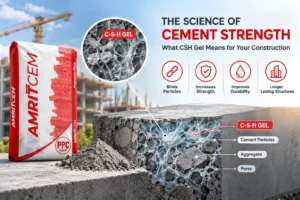
The grade of cement denotes its compressive strength — that is, the resistance of cement to load when cured — which it can sustain after 28 days.
- 43 grade cement achieves a strength of 43 megapascals (MPa).
- OPC 53 grade cement achieves 53 MPa.
However, these figures are not everything. How quickly each grade attains its strength, how much heat is released during setting, and how workable the cement is during construction all influence the final outcome.
OPC 53 Grade Cement – High Strength, Quick Results
What it is:
Ordinary Portland Cement (OPC) 53 grade is a high-strength cement that attains its target strength quickly. It develops 53 MPa in 28 days, with accelerated strength gain during the first week.
Best suited for:
- Reinforced Concrete Cement (RCC) structures such as beams, columns, and slabs
- Projects where load-bearing capacity is critical, such as high-rise buildings
- Flyovers, bridges, and other heavy infrastructure
- Projects with tight schedules requiring rapid formwork removal
Advantages:
- Provides early high strength, resulting in quicker construction cycles
- Shortens project schedules for large-scale infrastructure
- Ideal for structures with significant structural demands
Things to remember:
Since OPC 53 grade produces more heat during hydration, thorough curing is essential to prevent shrinkage cracks — especially in hot or dry climates. Proper curing is key to long-term durability.
43 Grade Cement – Steady Performance, Lasting Results
What it is:
43 grade cement develops its full strength gradually, reaching 43 MPa after 28 days. Its slower setting time and steady strength gain allow for more mixing, placing, and finishing flexibility.
Best suited for:
- Small houses or low-rise construction
- Plastering, flooring, and finishing works
- Basements and concreting of large sections
- Projects where climatic conditions or labour availability may cause delays
Advantages:
- Easier to apply due to slower setting time
- Releases less heat during hydration, reducing the risk of cracks
- Provides smoother finishes, making it excellent for plastering and masonry work
Things to remember:
While not as strong as OPC 53 grade, it is sufficient for most residential and non-heavy-load projects. It is also economical due to its balance of durability and workability.
Key Differences Between OPC 53 and 43 Grade Cement
| Feature | OPC 53 Grade Cement | 43 Grade Cement |
| At 28 days strength | 53 MPa | 43 MPa |
| Strength gain speed | Fast | Moderate |
| Suitable for | High-rises, bridges, RCC | Houses, plastering, base works |
| Heat generation | Higher | Lower |
| Workability | Less (fast setting) | Greater, smoother handling |
Cost Comparison Between OPC 53 Grade Cement and 43 Grade Cement
| Cement Grade | Avg. Price per 50kg Bag (₹) | Typical Use-case Cost Impact | Long-term Maintenance Cost |
| OPC 53 Grade Cement | ₹380 – ₹420 | Higher upfront material cost but reduced labour costs due to faster setting and early strength gain | Lower in heavy load structures due to durability |
| 43 Grade Cement | ₹340 – ₹380 | Economical for residential and finishing works | Slightly higher if used in high-load areas due to potential repairs |
Decision Table for Cement Grade Selection
| Factor | OPC 53 Grade Cement | 43 Grade Cement | Recommendation | Notes |
| Strength need | High | Moderate | 53 Grade for heavy load | Avoid 43 Grade in high-rises |
| Project scale | Large-scale | Small to medium | Match grade to scale | Can mix both for cost efficiency |
| Time constraint | Short timelines | Flexible timelines | 53 Grade saves time | 43 Grade allows more working time |
| Budget sensitivity | Moderate to high budget | Budget-friendly | Choose 43 Grade for savings | Bulk buying reduces cost |
Legal Standards and Compliance
In India, cement grades must comply with Bureau of Indian Standards (BIS) regulations:
- OPC 53 Grade Cement: IS 12269:2013
- 43 Grade Cement: IS 8112:2013
For government or heavy-load projects, compliance with these standards is mandatory. Always check the ISI mark and certification on packaging before purchase.
Brands to Look Out For
| Brand | Available Grades | Price Range (₹ per 50kg bag) | Strength & Durability Notes |
| Amrit Cement | OPC 53, OPC 43 | ₹350 – ₹400 | Competitive pricing, high workability, strong regional presence |
| UltraTech Cement | OPC 53, OPC 43 | ₹370 – ₹420 | Consistent quality and wide availability |
| Ambuja Cement | OPC 53, OPC 43 | ₹360 – ₹410 | Popular for residential use |
| ACC Cement | OPC 53, OPC 43 | ₹365 – ₹415 | Suitable for both small and large projects |
| Shree Cement | OPC 53, OPC 43 | ₹355 – ₹405 | Affordable, offers strong early strength |
Pre-purchase Guidance
- Geographical distribution: Choose a brand with a well-established dealer network in your region.
- Bulk buying tips: Negotiate with authorised dealers for transportation and bulk discounts.
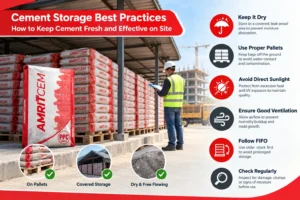
- Seasonal precautions: Store cement in moisture-free areas during monsoons; in summer, ensure proper curing to avoid cracks.
- Check freshness: Cement performs best within 90 days of production. Always check the manufacturing date.
Tips for Best Results
- Proper curing: Essential to prevent cracks and ensure long-term strength.
- Use the right cement for the right job: Avoid high-strength cement in non-critical applications to save costs.
- Correct storage: Store cement in a dry, moisture-free place.
- Freshness matters: Always use recently manufactured cement for best performance.
Professional Recommendation
- For structural components that require high load-bearing capacity and shorter construction time, use OPC 53 grade cement.
- For residential or finishing works where smoothness and aesthetics matter, use 43 grade cement.
- A combination of both grades can provide an optimal balance between strength and cost-effectiveness, ensuring durability and efficient project timelines.
Building the Future
Cement is not just a binding material — it is the backbone of your building. Choosing between OPC 53 and 43 grade cement means selecting the right properties for your project.
The right decision ensures satisfaction today and provides strength and reliability for decades to come. Whether it is the high performance of OPC 53 or the steady reliability of 43 grade, the right choice ensures every brick, beam, and slab comes together to create a lasting structure.
When you build, build wisely — so that your work outlasts walls, houses, and roofs, and becomes a heritage of trust.
FAQs – OPC 53 vs 43 Grade Cement
1. What is the main difference between OPC 53 and OPC 43 grade cement?
The primary difference is compressive strength. OPC 53 achieves 53 MPa strength after 28 days, while OPC 43 achieves 43 MPa. OPC 53 also gains strength faster, making it suitable for high-load and fast-track construction projects.
2. Which cement grade is best for house construction: OPC 43 or OPC 53?
For most residential homes, OPC 43 is sufficient and offers better workability for plastering, masonry, and general RCC work. OPC 53 is recommended when the structure requires higher load-bearing capacity or faster construction timelines.
3. Is OPC 53 cement stronger than OPC 43 cement?
Yes. OPC 53 develops higher compressive strength and achieves early strength gain faster than OPC 43. This makes it ideal for bridges, high-rise buildings, precast structures, and heavy RCC applications.
4. Does OPC 53 cement increase the risk of cracks?
OPC 53 generates more heat during hydration than OPC 43. If proper curing is not followed, shrinkage cracks may occur. Adequate curing and moisture control are essential for long-term durability.
5. Is OPC 43 cement more economical than OPC 53 cement?
Generally, OPC 43 has a lower upfront cost per bag and is more economical for residential and non-heavy-load applications. However, OPC 53 may reduce construction time and labour costs, which can improve overall project economics.
6. Can OPC 43 and OPC 53 cement be used in the same construction project?
Yes. Many builders use OPC 53 for structural elements such as columns, beams, and slabs, while using OPC 43 for plastering, masonry, flooring, and other non-critical applications to balance strength and cost.
7. Which cement grade is better for RCC structures?
OPC 53 is generally preferred for RCC structures because of its higher early strength, faster setting characteristics, and superior load-bearing performance.
8. How do I choose between OPC 43 and OPC 53 cement?
Choose OPC 43 for residential construction, plastering, and projects where workability and cost efficiency are priorities. Choose OPC 53 for high-rise buildings, bridges, heavy-load structures, and projects that require faster completion.