
Add water, however, and a series of chemical reactions begins. The mix starts losing its plasticity. It sets. It hardens. And over time, it develops the strength needed to hold a structure together.
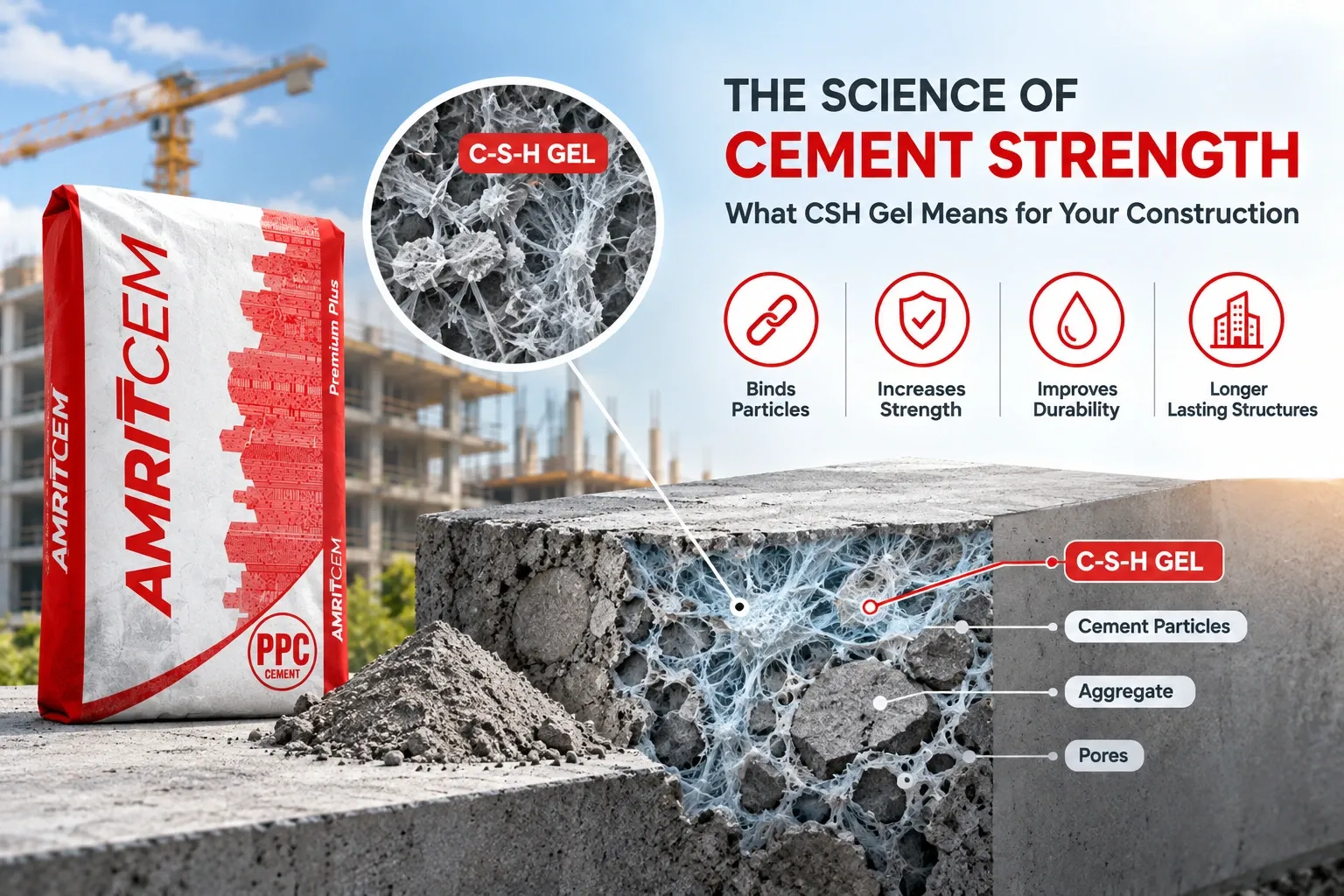
At the centre of this change is something most homeowners will never see: C-S-H gel, or calcium silicate hydrate.
It is one of the main products formed during the cement hydration process and one of the biggest reasons hardened cement paste develops strength.
Understanding it also explains several things that happen on a construction site. Why does concrete need water but too much water can weaken it? Why does curing matter after concrete already looks hard? And why does concrete continue gaining strength long after it has set?
The answers begin when cement meets water.
First, What Happens When Water Is Added to Cement?
Cement contains several compounds. Among the most important for strength development are calcium silicates.
Once water comes in contact with cement, these compounds begin reacting with it.
This is called hydration.
The cement hydration process does not simply mean that cement becomes wet. Water actually participates in chemical reactions that create new compounds.
Two important products emerge from the hydration of calcium silicates:
Calcium silicate hydrate (C-S-H) and calcium hydroxide.
For strength, C-S-H is particularly important.
What Exactly Is C-S-H Gel?
The word “gel” can make C-S-H sound soft or jelly-like.
That is not a useful way to picture it inside hardened concrete.
C-S-H forms as a very fine, poorly crystalline binding phase throughout the cement paste. As hydration continues, it develops around cement particles and fills part of the available space.
Gradually, this material binds the hardened cement paste together and contributes strongly to its mechanical strength.
This is why CSH gel strength is so closely connected with concrete strength.
You cannot see C-S-H developing at a construction site. But when a slab, column or foundation gains strength over time, C-S-H formation is an important part of what is happening inside it.
Concrete Does Not Become Strong the Moment It Sets
This distinction matters. Setting and strength development are not the same thing.
Fresh concrete gradually becomes stiff enough to lose its workable state. But hydration continues after this point.
More hydration allows more hydration products, including C-S-H, to develop. Concrete therefore continues gaining strength over time when conditions allow hydration to continue.
This is one reason construction teams should not treat a hard-looking concrete surface as proof that the concrete has finished developing.
The chemistry is still at work inside.
And it needs water.
This Is Why Curing Matters So Much
Once concrete has been placed and finished, it needs suitable moisture and temperature conditions.
That is the purpose of curing.
If concrete loses moisture too quickly, hydration can slow significantly. The concrete may not develop its intended properties as effectively as it would under proper curing conditions.
So, when workers keep a slab adequately moist, they are not simply “putting water on concrete.”
They are helping maintain the conditions needed for hydration to continue.
More complete hydration supports the continued development of cementitious products, including calcium silicate hydrate.
That is the science behind one of the simplest instructions heard on almost every construction site:
Do not neglect curing.
Then Why Not Add More Water While Mixing?
This is where cement chemistry becomes especially useful to understand.
Hydration needs water.
But that does not mean more mixing water automatically creates stronger concrete.
Only the required amount should be used according to the concrete mix design.
Excess mixing water creates additional space within the fresh cement paste. As that unnecessary water later leaves, it can leave behind capillary pores.
More connected pore space can make hardened concrete more permeable and can reduce its strength.
So there are two very different ideas here:
Concrete needs enough water for hydration and workability.
Concrete does not benefit from workers adding uncontrolled extra water simply to make the mix easier to handle.
That is why water-cement ratio matters.
C-S-H Also Helps Explain Why Concrete Becomes Denser
Think of fresh cement paste as a system containing cement particles, water and spaces between them.
Hydration gradually changes this internal structure.
As C-S-H and other hydration products form, they occupy space within the cement paste and bind the system together.
A well-designed and properly cured concrete mix can therefore develop a denser internal structure over time.
This matters for more than compressive strength.
A dense, low-permeability concrete structure can make it more difficult for water and aggressive substances to move through concrete. That becomes important for the long-term protection of reinforcement and overall durability.
Again, C-S-H is not working alone. Concrete performance depends on the entire mix and how it is handled on site.
PPC Adds Another Interesting Step to the Chemistry
The story becomes slightly different with Portland Pozzolana Cement, or PPC.
During normal cement hydration, calcium hydroxide forms along with C-S-H.
Pozzolanic materials such as fly ash contain reactive silica and alumina. Over time, these can react with calcium hydroxide in the presence of water and contribute to the formation of additional cementitious products, including additional C-S-H-type phases.
This secondary reaction is one reason PPC is associated with good long-term durability and a refined pore structure when used correctly.
It also explains why comparing OPC and PPC only on early strength can miss part of the picture.
Different cementitious systems can develop their properties at different rates.
The engineer therefore selects cement according to the needs of the structure rather than simply choosing whichever product appears to gain strength fastest.
What Can Disturb This Process on Site?
The chemistry may happen at microscopic scale, but everyday site decisions influence the conditions in which it takes place.
A few examples make this clear.
Too much mixing water: increases pore space and can reduce strength.
Poor curing: allows concrete to lose moisture needed for continued hydration.
Incorrect cement quantity or mix proportions: changes the designed concrete composition.
Poor compaction: leaves unwanted air voids and prevents concrete from becoming properly dense.
Very hot or dry conditions without protection: can cause rapid moisture loss from fresh concrete.
Poor cement storage: allows cement to react with atmospheric moisture before workers even use it.
This is why cement quality and workmanship cannot be separated.
A good cement gives the construction team the right material.
The team still has to create the right conditions for that material to perform.
What Does C-S-H Mean for Your House?
You do not need to check C-S-H on site.
You need to protect the process that creates it.
Follow the specified concrete mix.
Do not add extra water without technical approval.
Compact concrete properly.
Start curing at the appropriate time and continue it as specified.
Protect fresh concrete from conditions that cause rapid moisture loss.
Use cement that meets the required standards and project specifications.
These practices may sound basic. But at the microscopic level, they influence the environment in which cement hydrates and the hardened cement paste develops.
The Real Strength Is Being Built Where You Cannot See It
A concrete slab may look almost unchanged from one day to the next.
Inside it, the story is different.
Water is reacting with cement compounds. Hydration products are developing. The internal structure is changing. C-S-H is forming and contributing to the binding system that gives hardened cement paste much of its strength.
That is what makes the cement hydration process so important.
It also gives a different meaning to good construction practices.
Curing is not just a routine followed because “that is how concrete work is done.” Water control is not simply a rule written in the mix design.
Both affect the chemistry behind strength development.
You may never see calcium silicate hydrate in your home.
But much of the strength you depend on begins there.
FAQs
1. What is C-S-H gel in cement?
C-S-H stands for calcium silicate hydrate. It is a major binding product formed when calcium silicate compounds in cement react with water and is a major contributor to the strength of hardened cement paste.
2. What happens during the cement hydration process?
During the cement hydration process, cement compounds chemically react with water and form new hydration products. These include C-S-H and calcium hydroxide, among other products.
3. Why is C-S-H important for concrete strength?
C-S-H forms a fine binding phase within the cement paste. As hydration progresses, it helps bind the hardened paste together and contributes significantly to strength and the development of a denser microstructure.
4. Does more water create more C-S-H and stronger concrete?
No. Hydration requires water, but excess mixing water can create additional capillary pores as the concrete hardens. This can increase permeability and reduce strength. The correct water-cement ratio should therefore follow the approved concrete mix.
5. How does curing support CSH gel strength?
Proper curing maintains suitable moisture conditions so hydration can continue. This allows further development of hydration products, including C-S-H, and helps concrete develop its intended properties.