Honeycombing in Concrete: Causes, Prevention and Repair
The shuttering comes off a column. Instead of a solid, even surface, there are rough pockets where stones can be seen and cement mortar seems to be missing. Sometimes the damage is small. Sometimes it runs deep along the reinforcement.
This is called honeycombing. And covering it immediately with plaster is not a solution.
Understanding honeycombing in concrete causes is important because the visible holes may point to problems in placing or compacting concrete. The first job is to identify what happened. The next is to find out how serious it is.
What does honeycombing actually mean?
Concrete contains cement paste, sand and coarse aggregate. When placed correctly, the mortar fills the spaces around the stones and reinforcement. Compaction helps remove unwanted trapped air.
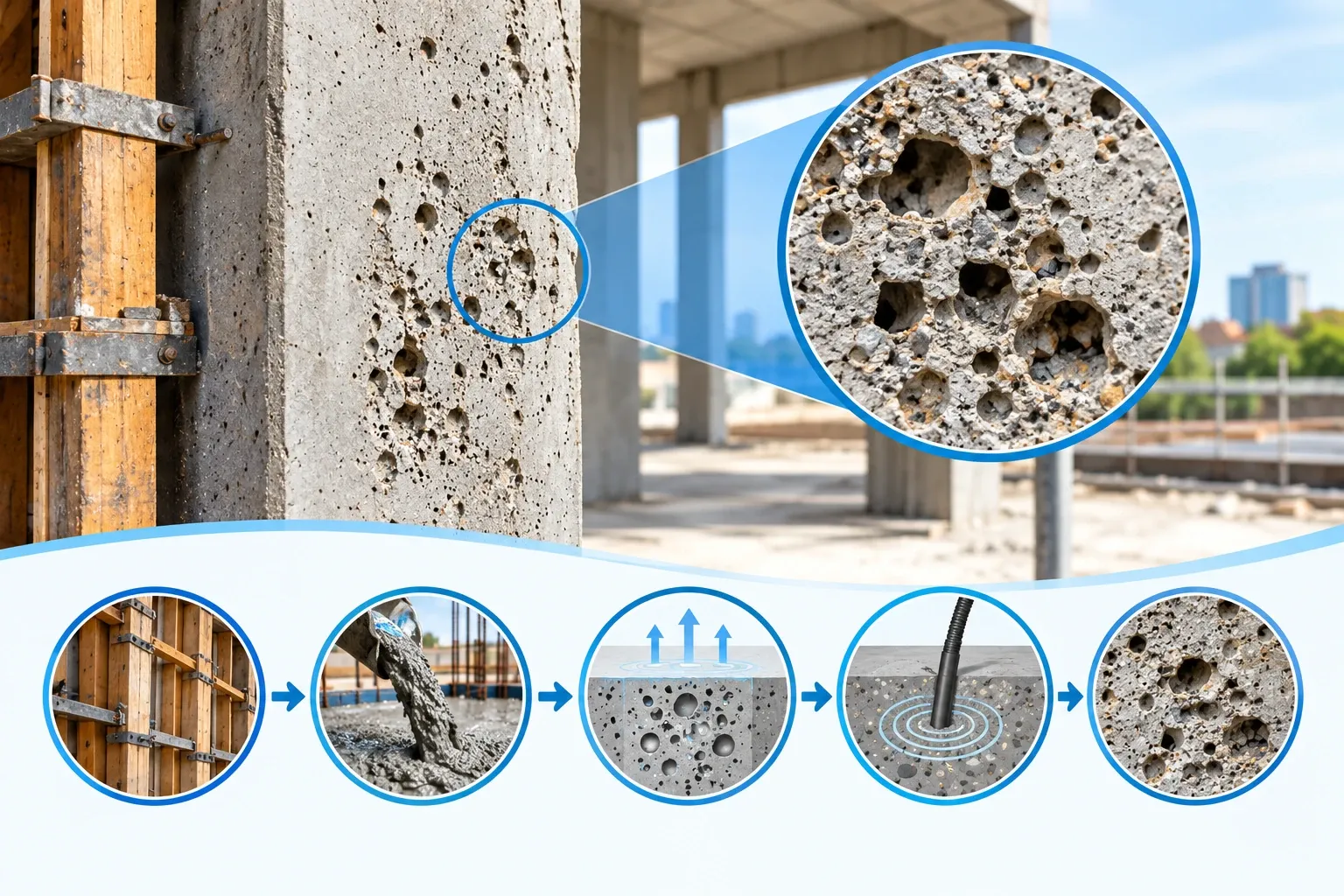
Honeycombing appears when pockets of the concrete are left without enough mortar or proper consolidation. The surface may show exposed aggregates, cavities or loosely packed stones. Some defects are shallow; others may extend into the member.
It should not be confused with a few small surface air holes, often called bugholes. A scattered pinhole on a formed surface is different from a deep pocket exposing steel or leaving large voids. That distinction matters because the repair method depends on the extent of the defect.
Cause one: concrete was not compacted properly
When concrete is poured, air is trapped between the ingredients. If it is not properly consolidated, air pockets can remain and harden into voids.
A needle vibrator helps suitable concrete flow around the reinforcement and fill the formwork. But merely owning a vibrator is not enough. Workers need to insert and use it correctly without leaving untreated areas.
Under-vibration is a common cause of honeycombing. Excessive vibration can also cause segregation in some mixes. Workers should follow the placement and compaction method approved for the job, rather than relying on guesswork.
Cause two: the concrete could not move through crowded steel
Think about a narrow column with closely spaced stirrups and several reinforcing bars. Large aggregate particles may struggle to pass through the gaps. If the mix is not suitable for that reinforcement layout, the mortar may move while stones become trapped.
The result can be cavities around the bars or along the edges. Changing the amount of water on site is not the correct fix. The engineer and concrete supplier should select a suitable aggregate size, mix workability and placement approach before casting.
In congested members, access for the placing hose and vibrator also needs planning. A workable concrete mix is one that can be placed and compacted for that particular element, not one that simply looks wet.
Cause three: the mix was harsh or poorly proportioned
If concrete contains too little effective paste or an unsuitable grading of aggregate, it may not flow into all the spaces inside the formwork. The mixture can look stony and difficult to compact.
Dirty aggregates, inconsistent batching or changes in water content can make matters worse. A contractor may try to overcome a stiff mix by adding water. That can create a different problem: separation of materials and a weaker paste.
The correct response is to follow the approved mix and use materials that meet the project specification. Cement quality matters, but honeycombing cannot be blamed on the cement brand without investigating the full process.
Cause four: shuttering leaked or concrete was dropped carelessly
Poorly sealed formwork joints can allow cement paste and fine mortar to escape while the concrete is being placed or vibrated. What remains may be a collection of coarse aggregate with too little mortar around it.
Long, uncontrolled free falls or careless placement can also encourage segregation. Concrete should be placed near its final position using an appropriate method, especially in deep columns and walls.
Strong, properly aligned shuttering is therefore part of concrete quality. It is not merely a temporary box that can be ignored after assembly.
What to do when honeycombing appears
Do not cover the area with cement slurry, paint or plaster before inspection. Take clear photographs, record the location and inform the site engineer.
The engineer should assess the size, depth and position of the defect. Is it a shallow surface pocket? Does it expose reinforcement? Is it located in a critical load-bearing region? Are there signs of wider poor compaction?
For minor, non-structural surface defects, a suitable repair mortar and approved surface preparation may be enough. Larger or deeper honeycombing may need removal of unsound material, testing, engineered repair or other action. In serious cases, replacement of the affected work may be necessary.
There is no safe single repair recipe for all honeycombing. The inspection comes before the material choice.
Why quick plastering can make things worse
Fresh plaster may hide a damaged column from view. But it does not automatically restore the strength, bond or durability of the original concrete.
Open voids can allow moisture and other harmful substances to reach reinforcing steel more easily. In wet regions, prolonged moisture exposure makes this especially important.
The repair must restore the required performance, not simply create a smooth surface for painting. A neat-looking column is not proof that the concrete below is sound.
Preventing honeycombing at the next pour
Start with the drawings. Check the reinforcement spacing, formwork condition and access for vibration. Confirm that the concrete mix and aggregate size suit the member.
Before pouring, seal shuttering joints, clear debris and plan how concrete will enter the formwork. During placement, use the approved lift heights and compaction procedure. Do not add water to correct a workability problem without authorised adjustments.
Supervisors should watch the corners, congested bar areas and difficult-to-reach sections. These are often the places where hurried work leaves defects.
After casting, protect the concrete and provide proper curing. Curing helps strength development, but it cannot fill large voids created during poor placement.
Northeast construction: one more reason to take voids seriously
Assam and Meghalaya experience long wet periods. Rain can delay pours, wet the aggregates and create storage problems. All three can affect consistency on site.
A sudden interruption may leave workers rushing to complete a column. Wet sand may change the mixing water. Formwork may not be checked carefully after a storm. Each problem is manageable if the team pays attention before casting.
In humid conditions, exposed reinforcement or large voids should never be dismissed as harmless simply because the outside can be plastered.
How Amrit Cement can support better practice
Amrit Cement offers OPC and PPC products for suitable construction applications. Product selection should follow the engineer’s specification and approved mix.
Through Amrit Support, the company lists raw-material guidance, site demonstrations, slump testing, cube testing and non-destructive testing services. These can help construction teams understand concrete consistency and quality checks. The need for any test, repair or structural decision must still be determined by the responsible engineer.
The best time to prevent honeycombing is before the shuttering goes up. The second-best time is before the next pour.
Before the next pour: a quick quality checklist
- Confirm the concrete mix and aggregate size were suitable.
- Check that reinforcement was not too congested for the placement method.
- Keep formwork joints sealed and the shuttering properly supported.
- Use an approved compaction method and trained workers.
- Record any interruptions or unusual changes during the pour.
- Inspect exposed concrete promptly and report suspicious voids.
FAQs
Is every hole on a concrete column honeycombing?
No. Small surface bugholes are not necessarily deep honeycombing. An engineer should assess larger cavities, exposed stones or reinforcement.
Can honeycombing reduce concrete strength?
Yes. Significant voids may reduce the effective concrete section and create paths for moisture. The effect depends on depth, location and extent.
Can workers repair it with normal plaster?
Plaster may hide the surface but does not necessarily restore structural performance. Repair should follow an engineer’s assessment and approved method.
Does using Amrit Cement prevent honeycombing?
No cement brand can compensate for poor batching, placement or compaction. Amrit Cement should be used with a suitable mix and correct workmanship.
Should concrete be vibrated more to avoid honeycombing?
Concrete needs appropriate consolidation, not unlimited vibration. Too little vibration can leave voids; excessive or unsuitable vibration may cause segregation.