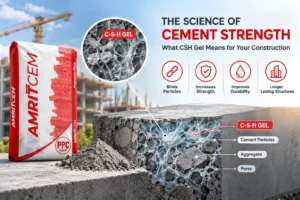
When we talk about cement strength, most people focus only on cement grade. But on actual construction sites, another factor quietly plays a huge role in how strong concrete becomes — cement fineness.
Cement fineness directly affects how fast cement reacts with water, how well it binds aggregates, and how much strength the concrete develops over time. Ignoring this factor can lead to slow strength gain, cracks, and durability issues.
Let’s understand the real role of cement fineness in strength development, in a way that makes sense on-site.
What Is Cement Fineness?
Cement fineness refers to how fine the cement particles are. Finer cement has smaller particles, which means a larger surface area comes in contact with water during mixing.
More surface area = faster chemical reaction = better strength development.
How Cement Fineness Affects Strength Development
1. Faster Hydration and Early Strength
Fine cement reacts quickly with water. This results in:
- Faster setting
- Better early-age strength
- Stronger initial bonding in concrete
This is especially useful in RCC Dhalai, where early strength is important for formwork removal.
2. Better Bonding with Aggregates
Finer cement particles fill the gaps between sand and aggregates more effectively. This improves:
- Concrete density
- Bond strength
- Load-bearing capacity
Poor fineness can leave voids, making concrete weak from inside.
3. Uniform Strength Throughout the Structure
Good cement fineness ensures:
- Even strength across slab, beam, and column
- Reduced chances of honeycombing
- Better surface finish
This consistency is critical for long-term durability.
4. Impact on Long-Term Strength
While fineness helps early strength, balanced fineness ensures:
- Controlled heat of hydration
- Steady long-term strength gain
- Reduced crack formation
Overly coarse cement may gain strength slowly, while poorly controlled fineness can affect durability.
Problems Caused by Poor Cement Fineness
- Slow strength development
- Weak bonding
- Increased permeability
- Cracks due to uneven hydration
- Reduced lifespan of RCC structures
These issues often appear months or years after construction.
How Cement Fineness Is Controlled
Quality cement manufacturers control fineness through:
- Advanced grinding technology
- Regular lab testing (Blaine fineness test)
- Strict quality standards
- Batch-wise consistency checks
This is why cement from reliable brands performs better on-site.
Practical Site Tips for Contractors
- Use cement from trusted brands only
- Avoid mixing cement from different batches
- Check cement freshness and storage condition
- Follow proper curing for best strength results
Conclusion
Cement fineness plays a silent but powerful role in how strong concrete becomes. It affects hydration speed, bonding quality, and both early and long-term strength. Choosing cement with controlled and consistent fineness is just as important as choosing the right grade.
Amrit Cement is manufactured with advanced grinding technology and strict quality control to ensure optimal fineness, helping concrete gain strong, uniform, and long-lasting strength. When you choose Amrit Cement, you’re choosing reliability that performs consistently on-site.

Frequently Asked Questions (FAQs)
What is cement fineness?
Cement fineness refers to how fine the cement particles are, which affects hydration speed and strength development.
How does cement fineness affect concrete strength?
Finer cement reacts faster with water, leading to better bonding and higher early strength.
Is very fine cement always better?
No. Cement must have balanced fineness. Too fine can increase heat of hydration, while too coarse slows strength gain.
How can cement fineness be tested?
Cement fineness is tested using methods like the Blaine air permeability test.
Can poor cement fineness cause cracks?
Yes. Uneven or poor fineness can lead to improper hydration and crack formation.

Why should I choose branded cement for Dhalai?
Branded cement ensures controlled fineness, consistent quality, and reliable strength performance.
How does Amrit Cement ensure good strength?
Amrit Cement maintains optimal fineness and strict quality control, ensuring strong and durable concrete.