
When you search for information about the cement manufacturing process, it’s often explained in technical detail — but not many resources tell you what matters when making commercial decisions: how different stages impact quality, cost, delivery timing, and ultimately project performance.
This blog explains the cement production process not just as a sequence of steps, but as a practical guide that helps you understand cost drivers, quality checkpoints, and what to look for when choosing a cement brand like Amrit Cement.
Why Knowing about the Process Matters Commercially
You ought to concentrate not in memorising industry jargon, but rather on:
- Which stages are the most cost-influencing
- Where there is defect or variability possible
- How quality is ensured
- The impact of the manufacturing strategy on performance and maintenance
This information will assist you in advancing better procurement choices, deal with dealers and set up your construction budget more precisely.
General Introduction to the Process of Cement Manufacturing
At its core, the cement production process has three major phases:
- Raw Material Procurement / Preparation
- Clinker Production
- Final Grinding & Packing
There are commercial implications of each stage as explained below.
Raw Material Procurement and Preparation
Cement is composed of the base components, which are usually:
- Limestone
- Clay
- Silica
- Iron ore
These are collected from quarries within the vicinity of the plant.
The selection of the quarry and the quality of material is significant as:
- Defects in the raw materials may lead to non-uniform clinker quality, necessitating additional re-work in the kiln process and thereby increasing cost.
- The location regarding the production sites influences freight and handling charges.
Amrit Cement uses certified quarries with a uniform composition so that variation in the production line is reduced. This consistency in the quality of the inputs used also makes sure that every packet of cement delivers as expected in terms of strength and durability, which in the long run will affect the maintenance cost of the builders.
Crushing and blending is done in order to obtain a homogenous chemical mixture. This combination is continuously monitored in contemporary plants in order to minimize the amount of waste and ensure a predictable quality.
Clinker Manufacturing: The Center of Cement Quality
The mixture of the raw material is then heated using a rotary kiln at very high temperatures (approximately 1450°C). This is the most energy-intensive part of the cement manufacturing process.
Commercial impact of this stage:
Heat Source and Efficiency
Fuel (such as coal or petcoke) is an important cost driver. The efficient use of fuel lowers the manufacturing cost — gains which can be transferred to dealers and eventually to buyers.
Clinker Quality Controls
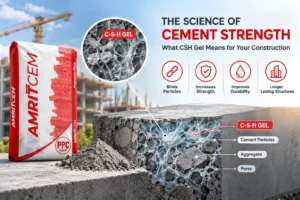
The quality of clinker, which determines cement strength, is influenced by temperature control and residence time in the kiln.
- Weak combustion or temperature oscillations result in incomplete combustion
- This leads to increased use of corrective grinding and additives
High-level plants such as those employed by Amrit Cement have real-time sensors and quality controls that monitor the consistency of the clinker. This increases the chances of obtaining reliable concrete at the worksite and reduces the risk of structural issues or premature repairs.
Final Grinding and Packing
After being mixed with gypsum (to regulate the setting time) and occasionally additives (to improve characteristics), clinker is finely ground into cement powder.
This phase impacts:
- Setting time
- Compressive strength
- Workability
Commercial considerations:
- Finer grinding improves performance but increases power consumption and cost.
- Additives such as pozzolans enhance durability, especially in coastal or high-moisture environments.
The grinding practices at Amrit Cement are tuned to provide a balance between performance and efficiency. For buyers, this translates into dependable setting behaviour, strong strength gain, and value for money.
Packing and bagging, although often overlooked, influence logistics cost. Poor bagging increases breakage loss during transit, while sealed bags minimise wastage and preserve quality until use.
What This Implies to Your Project
Understanding the cement production process allows you to evaluate supplier offerings beyond just the price.
Key considerations before purchase:
Standards of Quality and Compliance
All cement sold in India must comply with BIS (Bureau of Indian Standards) specifications and be classified under applicable types such as OPC or PPC.
Manufacturers like Amrit Cement also test and certify their products according to these norms.
Ensure cement bags include:
- Valid ISI mark
- Grade designation (e.g., PPC / OPC 43 / OPC 53)
- Manufacturer details and batch number
Non-compliant products may appear cheaper initially but often lead to poor performance and higher maintenance costs later.
Checklist for Buyers (Commercial Perspective)
Key buying criteria linked to manufacturing stages include:
Source of Raw Materials
Ask suppliers about the origin of raw materials and how consistency is maintained.
Production Technology
Check whether modern sensors and automated controls are used. Higher automation generally reduces defects.
Clinker Quality and Storage
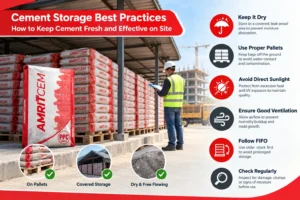
Poor storage can allow moisture absorption, reducing cement performance. Well-managed plants control this risk.
Fineness and Additives in Grinding
Confirm whether the cement blend suits your structural or environmental needs (e.g., sulphate resistance).
Logistics and Delivered Cost
Cement may be competitively priced at the plant, but transport costs—especially in Assam and the Northeast—can significantly affect final pricing.
Purchasing Intelligence Based on Manufacturing Insight
- Compare delivered price per bag to your location, not just ex-factory price.
- Buy in bulk during low-demand periods to secure better pricing.
- Monitor seasonal price patterns, as rates often rise before monsoons and festive construction seasons.
- Request test certificates for the batch being purchased.
- Evaluate long-term maintenance implications, as cheaper cement may result in higher repair costs over time.
Final Thoughts
The cement manufacturing process is not merely a technical checklist; it has real commercial implications for builders and contractors.
By understanding how raw materials, heat processing, grinding, and quality control influence both performance and cost, you can select cement that delivers durability, value, and long-term reliability.
The production strategy used by Amrit Cement focuses on consistency, regulatory compliance, and efficient clinker and grinding processes—helping end users receive not just cement, but dependable performance throughout the lifespan of their structures.
FAQ 1: Why should a home owner care about how cement is manufactured?
As a home owner, the manufacturing process directly affects cement strength, durability, and consistency. Poor manufacturing can lead to cracks, weak concrete, and higher repair costs later. Amrit Cement follows controlled processes—from raw material selection to final grinding—to ensure uniform quality. This means better bonding, long-lasting structures, and peace of mind that your investment in construction will stand strong for years.
FAQ 2: How does cement quality impact a contractor’s work on site?
For contractors, consistent cement quality saves time and reduces material wastage. Cement with uneven strength can cause setting issues and rework. Amrit Cement’s controlled manufacturing ensures predictable setting time and strength development, helping contractors maintain work schedules, reduce complaints, and deliver reliable results to clients—critical for business reputation and repeat projects.
FAQ 3: Does modern manufacturing really improve cement performance?
Yes. Modern manufacturing improves fineness, strength uniformity, and durability. Advanced kilns, automated grinding, and lab testing help Amrit Cement maintain consistent performance across batches. For builders and contractors, this means fewer surprises on site, smoother concrete mixes, and better structural outcomes—especially important for large or commercial projects.
FAQ 4: How does manufacturing quality affect long-term building costs?
Good manufacturing reduces long-term maintenance costs. High-quality cement resists cracks, moisture damage, and strength loss over time. Amrit Cement’s strict production controls help structures stay strong, reducing future repair expenses for home owners and ensuring contractors deliver lasting value to their clients.
FAQ 5: How can buyers identify well-manufactured cement?
Buyers should look for trusted brands, BIS compliance, consistent packaging, and good on-site performance. Amrit Cement follows strict quality checks at every stage, ensuring each bag delivers dependable strength. Choosing such cement protects both construction quality and business credibility.