That Damp Patch on Your Wall May Have Started Below the Floor
You paint it.
It comes back.
You apply putty.
It comes back.
You repaint with a more expensive product.
A few months later, there it is again. The problem may not actually be the paint.
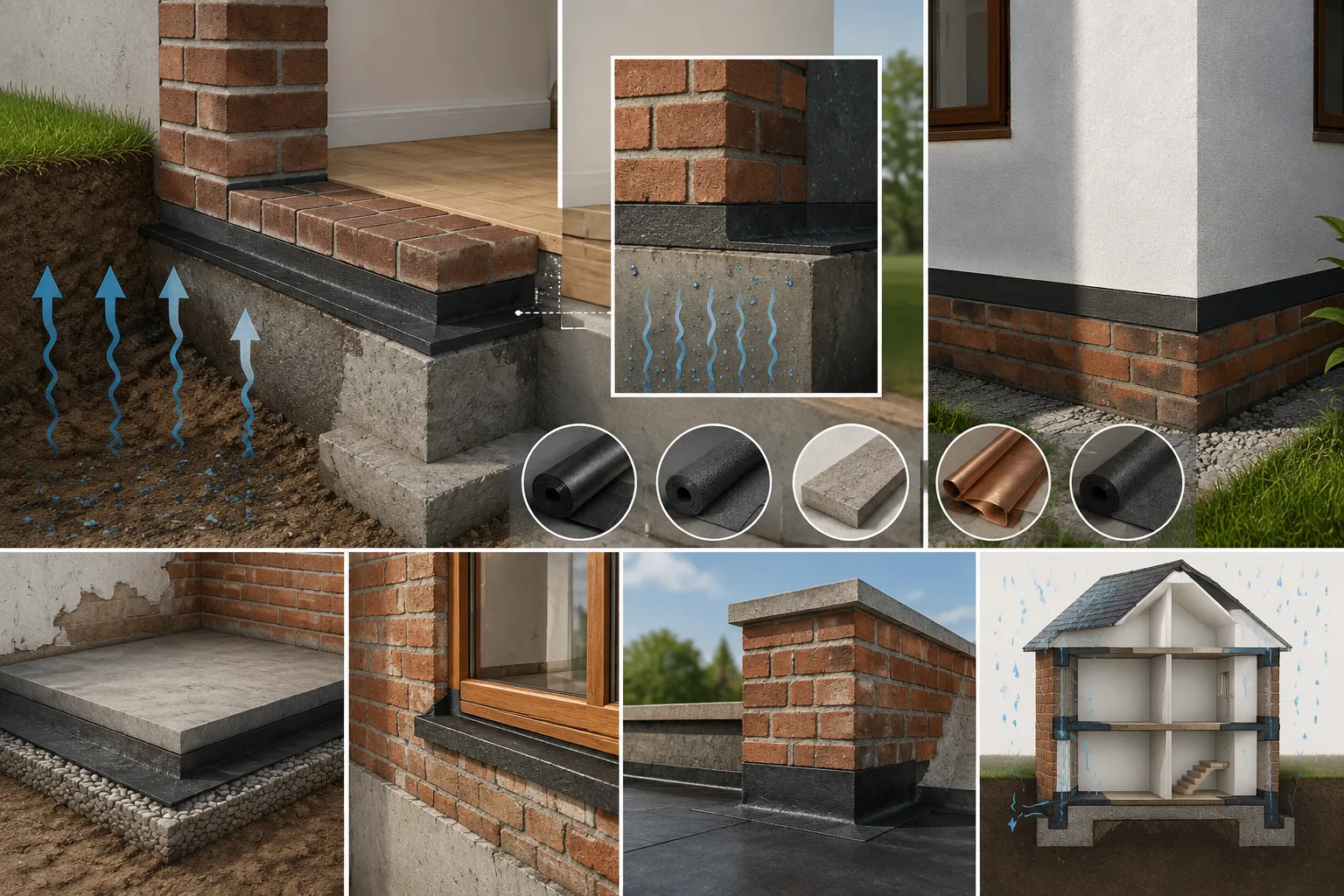
Moisture can travel upward from the ground through the tiny pores in bricks, mortar and concrete. This movement is known as capillary action.
Once it enters the wall, you may eventually notice peeling paint, damp patches, salt deposits, damaged plaster or a persistent musty environment.
This is exactly the problem a damp proof course, or DPC, is intended to stop. And unlike paint, DPC is not something you add when the house starts looking damp. It needs to be planned while the house is being built.
First, What Is the Meaning of DPC?
The DPC meaning is quite straightforward. DPC stands for Damp Proof Course.
It is a continuous moisture-resistant barrier incorporated into a building to prevent moisture from travelling from the ground into walls and other parts of the structure.
Think of the wall like a sponge standing in shallow water. Given enough time, moisture can move upward through its pores. Now place an impermeable layer between the sponge and the water.
The path is interrupted. A DPC works on essentially the same principle. It breaks the route through which ground moisture would otherwise rise into the building.
Where Is DPC Provided in a House?
In typical residential construction, horizontal DPC is commonly provided at the plinth level, above the surrounding ground level and below the superstructure walls.
Why there?
Because this is where the building transitions from a foundation exposed to the ground to walls that need protection from rising moisture.
But damp proofing in construction is not limited to one horizontal strip.
Depending on the design and exposure conditions, damp-proofing or waterproofing measures may also be required around:
- Basement walls
- Floors in contact with the ground
- Retaining walls
- Parapets
- Bathrooms and wet areas
- Roofs and terraces
- Areas exposed to external soil
The exact system depends on where the moisture is coming from.
Why Does Moisture Rise Through a Wall?
Concrete and masonry may look completely solid. Microscopically, they aren’t. They contain interconnected pores. When the lower part of a wall remains in contact with damp soil or moisture, water can travel through these small pores by capillary action. It may continue moving upward until evaporation and gravity eventually limit its rise. And water rarely travels alone. It can carry dissolved salts with it.
When the moisture reaches the surface and evaporates, those salts can remain behind as white deposits known as efflorescence.
So, when you see a powdery white layer near the bottom of an old wall, you may be looking at evidence of moisture movement rather than simply a paint problem.
The Importance of DPC Becomes Clear Years Later
Nobody walks into a newly completed house and admires the DPC. You can’t see it. That’s precisely why it gets ignored. But a correctly designed and executed DPC in Building Construction helps protect the building against several moisture-related problems.
It helps stop rising damp
This is its primary job. DPC creates a barrier between moisture in the ground and the masonry above it.
It protects plaster and paint
When moisture repeatedly reaches wall finishes, paint can blister, plaster can deteriorate and decorative finishes can fail.
Stopping the moisture at its source is much more effective than repeatedly repairing the visible symptoms.
It helps protect building materials
Persistent moisture can contribute to deterioration of masonry and finishes and can create conditions that are harmful to some building components.
It improves indoor conditions
Continually damp surfaces can encourage mould growth and create unpleasant indoor conditions.
This is why the importance of DPC goes far beyond keeping a wall visually clean.
It is part of protecting the building envelope itself.
Types of DPC Used in Construction
There isn’t one universal DPC material.
The appropriate system depends on the building design, moisture exposure, substrate and project specification.
The commonly encountered types of DPC can broadly be understood by the materials used.
1. Cement Concrete DPC
A dense cement concrete layer is traditionally used at plinth level in many Indian buildings.
The concrete is laid continuously across the wall thickness and may be used with an approved waterproofing treatment depending on the specification.
The key word here is continuous.
A gap in the DPC gives moisture a route around the barrier.
2. Bituminous DPC
Bitumen-based materials have long been used for damp proofing because of their water-resistant properties.
Systems may include bituminous coatings, membranes or felt products depending on the application.
They can be useful where a flexible moisture barrier is required, but surface preparation and correct installation are critical.
3. Plastic or Polyethylene Membranes
Polyethylene and other polymer-based sheets can create an effective moisture barrier when correctly specified and installed. They are lightweight and relatively easy to handle. But a membrane works only while it remains continuous. Puncture it during construction and its effectiveness can be reduced.
4. Mastic Asphalt
Mastic asphalt creates a dense, impermeable layer and has traditionally been used for damp-proofing applications.
It may be specified where a robust barrier is required, although its installation generally needs skilled workmanship and correct substrate preparation.
5. Metal Sheet DPC
Materials such as lead, copper or aluminium have historically been used as DPC in specialised situations.
They can provide a durable impermeable barrier, but cost, corrosion considerations, compatibility and installation requirements mean they are less common in ordinary residential work today.
DPC Is Not the Same as Waterproofing
This distinction is worth understanding.
A damp proof course primarily prevents moisture movement through building elements, particularly rising damp from the ground.
Waterproofing is generally designed to resist more substantial water exposure and, depending on the system, hydrostatic pressure.
A basement wall facing groundwater needs something very different from a wall simply being protected against capillary moisture.
Likewise, a bathroom floor needs a different treatment from a plinth-level DPC. Calling everything “waterproofing” can lead to the wrong solution being used in the wrong place.
How DPC Is Provided at Plinth Level
The drawings and project specification should always decide the exact construction method, but the basic process is easy to understand.
Step 1: Prepare the surface
The top of the plinth or masonry should be level, clean and free from loose particles. An uneven or dirty surface can affect continuity.
Step 2: Lay the specified DPC
The specified concrete, membrane or other damp-proof material is installed across the full wall width. Corners and junctions need particular attention.
Step 3: Maintain continuity
This is critical. DPC should connect properly with adjoining damp-proofing systems so moisture cannot bypass the barrier through gaps.
Step 4: Protect it during later construction
A membrane can be damaged by tools, reinforcement, masonry work or careless movement. Once damaged and covered, finding the defect becomes difficult.
Step 5: Inspect before covering
Check the DPC before the wall construction proceeds. This may be the last easy opportunity to correct a defect.
The Most Expensive DPC Mistake Can Be a Tiny Gap
Imagine an umbrella with one small hole. Ninety-nine per cent of it still works.
You still get wet. DPC behaves similarly.
A beautifully installed barrier across most of the wall can still fail locally if moisture finds a continuous path around it.
Common mistakes include:
- Discontinuous DPC at corners
- Incorrect DPC level
- Membrane punctures
- Poorly prepared surfaces
- DPC not covering the complete wall thickness
- Bridging the DPC with mortar or debris
- Poor connection between horizontal and vertical damp-proofing
- Ignoring external ground levels after construction
That last point deserves attention. If soil, paving or landscaping is later raised above the DPC level, moisture may bypass the barrier altogether. A perfectly good DPC can therefore be defeated by poor work done months later.
DPC Matters Even More Where Rain Is Part of Everyday Life
For homes in Assam, Meghalaya and other high-rainfall parts of Northeast India, moisture management should begin at the design stage. Heavy rainfall can keep surrounding soil wet for extended periods.
Good damp proofing in construction therefore needs to work together with:
- Site drainage
- Appropriate plinth height
- Roof drainage
- Proper external grading
- Waterproofing in exposed areas
- Good-quality concrete and masonry
- Correct curing
DPC cannot compensate for water continuously collecting against the building. Think of moisture protection as a system. DPC is one important part of it.
Cement Quality Still Matters
When cement-based DPC, plinth concrete, masonry and plaster are involved, material quality and workmanship remain important.
A dense, properly mixed and correctly cured cementitious layer performs differently from one made with excess water and poor compaction.
Quality cement such as Amrit Cement, combined with the specified mix proportions, correct application and proper curing, can support durable construction throughout the plinth and masonry stages.
But cement alone cannot make a building damp-proof. The DPC design, drainage, waterproofing and workmanship have to work with it.
Stop Dampness Before You Have a Wall to Paint
That is probably the simplest way to understand the importance of DPC.
Once damp patches appear inside a finished home, fixing the root cause can involve removing plaster, investigating moisture paths and carrying out specialised remedial work.
During construction, the same problem may have been preventable with one correctly designed and carefully installed barrier.
DPC isn’t glamorous. It doesn’t improve the elevation. Nobody will compliment it during your housewarming. But ten monsoons later, when the bottom of your walls is still dry and the paint is where it belongs, you may appreciate the construction detail you never actually got to see. Because some of the most valuable parts of a house are the ones designed to disappear inside it.
Frequently Asked Questions
What is DPC in building construction?
DPC in Building Construction means Damp Proof Course, a moisture-resistant barrier installed within a building to help prevent ground moisture from rising into walls and other structural elements.
Where is DPC normally provided?
Horizontal DPC is commonly provided at plinth level, above the surrounding ground and beneath the walls of the superstructure. Other damp-proofing systems may be required in basements, ground floors and moisture-exposed locations.
What are the common types of DPC?
Common types of DPC include cement concrete DPC, bituminous systems, plastic or polyethylene membranes, mastic asphalt and, in specialised applications, metal sheets.
What happens if DPC is not provided?
Without effective DPC, ground moisture may rise through porous masonry and contribute to damp patches, efflorescence, damaged plaster, peeling paint and unhealthy indoor conditions.
Is DPC the same as waterproofing?
No. DPC primarily controls moisture movement such as rising damp. Waterproofing systems are designed for areas exposed to more direct or substantial water ingress and may need to withstand water pressure.
Can DPC completely prevent dampness in a house?
No single measure can. Effective moisture protection also depends on drainage, external ground levels, roof water management, waterproofing, good masonry and correct construction practices.