
RCC Slab Strength Checking: Tests and Safety Checklist
A new RCC slab often looks finished long before the work around it is finished. The surface has hardened. The shuttering team wants its materials back. Bricks for the next floor are waiting at the gate.
But can the site safely move ahead?
RCC slab strength checking is not one quick test or a fixed number of days. It is a set of checks covering concrete strength, curing, temporary supports and the loads planned for the next stage. The engineer must bring those details together before the work changes.
For homeowners, the important thing is to know what evidence to ask for.
First, define the next construction stage
‘Continue construction’ can mean different things. Removing side formwork is not the same as removing props from below the slab. Allowing limited access is not the same as stacking hundreds of bricks. Building masonry above a beam is not the same as preparing formwork to cast another level.
Each activity places a different demand on the structure. So the first question should be: what exactly will happen next, where will the load be placed, and who has approved it?
The responsible structural engineer should confirm the construction sequence, permitted loads and required temporary supports. A general site timetable cannot replace that plan.
Check the basic casting record
Before discussing tests, collect the facts about the pour. What was the casting date? Which concrete grade and approved mix were used? Was the mix produced at a batching plant or at the site? Were there interruptions or heavy rain? Was any extra water added?
Check the delivery notes, batch records and site diary where available. Record the cement type and any admixtures. These details help explain why one slab may gain strength differently from another.
A clean record does not guarantee good concrete, but missing records make decisions harder. The construction team should know what was placed before asking whether it is ready to carry more.
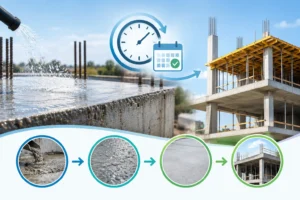
Review the curing, not just the calendar
Concrete gains strength as cement reacts with water. Suitable curing conditions help that process continue.
If the slab was left exposed to strong sun and wind, or if curing stopped too soon, its actual performance may differ from expectations. Heavy rain can also damage very fresh surfaces, even though later controlled moisture is useful for curing.
Ask whether the specified curing method was followed and for how long. Check whether ponding, wet coverings or an approved curing compound was used correctly. A slab that looks dry cannot tell you how well it was cured.
With PPC concrete, strength development may follow a different pattern from OPC concrete. That is one more reason to rely on the project specification and evidence, not a fixed assumption.
What a cube test can and cannot tell you
Concrete cube tests measure compressive strength of sampled concrete under defined testing conditions. Results at specified ages, often including 7 and 28 days, provide useful information about the concrete supplied or produced.
However, a test cube and a slab do not always have the same curing history. Standard-cured cubes are mainly used to assess the concrete against specified strength requirements. If a decision depends on strength actually achieved in the structure at an early age, the engineer may need a different approach.
Field-cured specimens, calibrated maturity methods or suitable other assessments may be considered where the project permits them. Tests should be performed and interpreted by competent people. An isolated number from a testing machine should not become a do-it-yourself loading certificate.
Visual inspection still matters
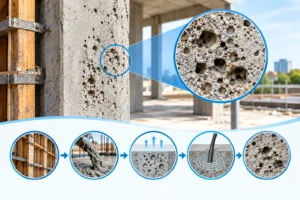
A site engineer should inspect the slab and supporting members for obvious problems. Look for unusual cracking, honeycombing at edges or beams, damaged areas, poor construction joints or signs that the formwork moved during pouring.
Visual inspection has limits. An apparently smooth surface does not prove that the inside of the slab is free from defects. But visible problems should be investigated before heavier work is allowed.
If reinforcement has become exposed, if cracks appear unusual or if there has been a serious incident during casting, do not simply continue because the scheduled date has arrived. Ask for an engineering assessment.
Do not remove props simply to speed up work
This is one of the most important checks.
Props, formwork and reshores help manage loads while the slab is gaining strength and during later construction. Their removal can shift weight to the concrete and other floors. The sequence must follow the engineer-approved plan and the applicable project requirements.
A contractor may say that the team removed props after the same number of days on another building. That does not prove this slab is ready. Span, concrete strength, weather, support layout and planned loading all matter.
If new formwork is being erected above, the loading on lower floors must also be considered. More than one slab may be carrying the weight of construction.
Material storage is a structural question
A stack of cement bags or bricks concentrated in one location can create high loads. It may be convenient for workers, but convenience is not a safe load plan.
Agree on temporary storage locations and quantities before materials are lifted. Keep access routes clear and avoid placing heavy loads near unapproved edges or openings. The engineer must decide what loads are acceptable and whether additional support is required.
Even a strong slab can be overloaded during construction if the site treats it like a general storage yard.
When should additional testing be considered?
Tests may be useful when records are missing, results are doubtful, curing was interrupted or visible defects raise concerns. Non-destructive methods can help an engineer investigate concrete condition, but many methods do not directly measure in-place compressive strength without proper correlation.
Core testing or other procedures may sometimes be considered. Because these can affect the structure, they require professional selection, execution and interpretation.
The goal is not to collect as many test reports as possible. It is to answer a defined engineering question using reliable evidence.
Checks that matter during Northeast monsoons
Assam and Meghalaya sites face additional problems when rain interrupts casting or makes aggregate moisture difficult to control. Keep notes of rainfall during and after the pour. Check that no unapproved water was added to the mix and that fresh concrete was protected.
Cement bags should remain dry before use. On sloping sites, formwork access and temporary supports need extra attention after a downpour.
These precautions cannot replace a strength assessment, but they help explain what happened on the day the slab was cast.
Site checklist before the next activity
- Identify the exact work and loads planned for the next stage.
- Review casting records, mix details and curing history.
- Ask the engineer to interpret available strength results.
- Inspect visible defects and investigate concerns.
- Confirm formwork, props and reshoring instructions.
- Approve temporary material storage locations.
- Record the engineer’s decision before work changes.
FAQs
Can I judge RCC slab strength by walking on it?
No. A surface that supports foot traffic does not prove the slab can carry construction materials or another level of formwork.
Is a 28-day cube result enough to start the next floor?
It is useful strength information, but the engineer must also review loading, supports, design and actual site conditions.
Are slump tests used for hardened slab strength?
No. A slump test checks the consistency of fresh concrete. It does not measure the strength of a hardened RCC slab.
Can NDT alone certify that a slab is safe?
Not automatically. Non-destructive test results need competent interpretation and may require correlation with other evidence.
Does Amrit Support give approval for slab loading?
Amrit Support offers listed testing and guidance services. Structural loading and construction-stage approval remain with the responsible engineer.